California’s Housing Shortage Keeps Fueling Multifamily Investment, New Survey Finds
California’s persistent housing shortage remains one of the strongest tailwinds for multifamily investment in the state, according to newly released survey data from the Allen Matkins/UCLA Anderson Forecast California Commercial Real Estate Survey. The Summer 2026 edition finds that commercial real estate professionals across the state still see apartment demand running well ahead of new supply — a gap that continues to make multifamily one of the more resilient property types heading into the back half of the year.
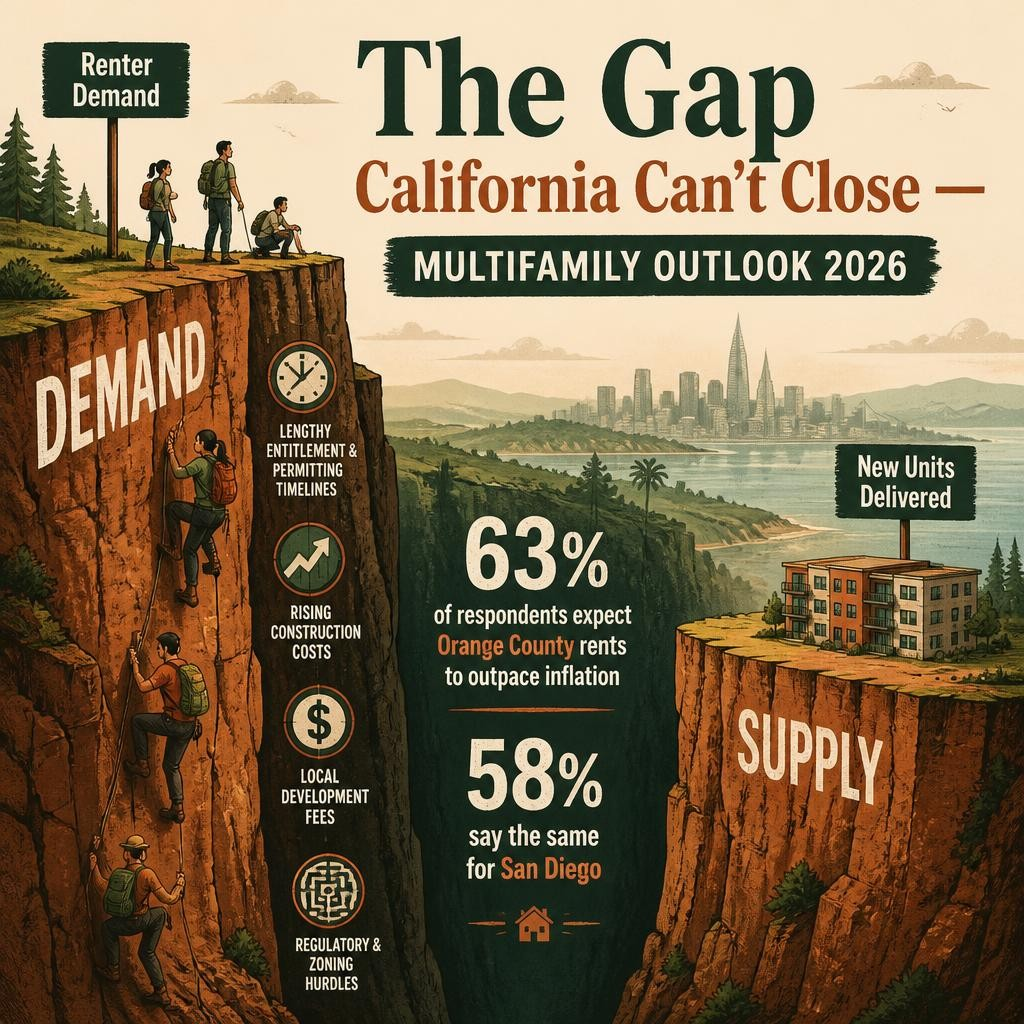
Survey respondents in both major California markets expect the imbalance between renter demand and available housing to persist over the next three years. In Northern California, 75% of respondents said they expect multifamily demand to exceed supply, while 64% of Southern California respondents share that outlook. That gap between the two regions shows up in development plans as well: 64% of Northern California respondents report they have at least one new multifamily project planned within the next 12 months, compared with 48% of their Southern California counterparts.
Rent Growth Expected to Hold Up
Even with broader economic uncertainty, survey participants expect apartment rents in key Southern California submarkets to keep outpacing inflation. Roughly 63% of respondents anticipate Orange County rents will grow faster than inflation, and 58% expect the same trend in San Diego. For owners and investors, that combination of tight supply and durable rent growth continues to underpin multifamily’s appeal relative to other commercial property types.
What’s Holding Back New Supply
Despite strong underlying demand, the survey highlights a widening gap between what the market wants and what’s actually getting built. Respondents pointed less to weak fundamentals and more to structural obstacles slowing new housing delivery, including:
Lengthy entitlement and permitting timelines
Rising construction costs
Local development fees
Regulatory and zoning hurdles
Together, these factors are keeping California’s housing pipeline well below what population and job growth would otherwise support — reinforcing the long-term case for multifamily even as near-term development activity cools in some submarkets.
An Industry Voice on the 2026 Outlook
Michael Van Every, President and Managing Partner of Republic Urban Properties, summed up the current environment as a mixed bag for developers. He noted that in the Bay Area, rents are climbing alongside job growth tied to AI-driven hiring, but ground-up development remains difficult to pencil given continued uncertainty around where interest rates — and treasury-linked borrowing costs — head next.
The Takeaway for Multifamily Owners and Investors
The Summer 2026 findings reinforce a theme that’s held for several survey cycles now: California’s structural housing shortage isn’t going away, and it continues to support multifamily fundamentals even when development activity is constrained by cost and regulatory friction. For owners, investors, and brokers active in California multifamily — from the Bay Area to Southern California submarkets like South Bay, Orange County, and San Diego — that combination of durable demand and constrained new supply remains a key factor shaping pricing, rents, and investment strategy through the rest of 2026.
Source: Allen Matkins/UCLA Anderson Forecast, Summer 2026 California Commercial Real Estate Survey, released August 26, 2026.