1031 Exchange for Los Angeles Apartment Owners (2026)
Selling a Los Angeles apartment building can trigger a large tax bill: federal capital gains tax, the 3.8% net investment income tax, tax on the depreciation you’ve taken, and California income tax. A Los Angeles 1031 exchange lets you defer those taxes by rolling your proceeds into another investment property, so your full equity keeps working for you. This guide covers the federal rules, how Measure ULA and transfer taxes change the math in the City of Los Angeles, how RSO buildings fit in, and the strategies Westside owners use.
(General information only, not tax or legal advice. 1031 rules are technical and your situation is specific, so work with a Qualified Intermediary and your CPA or attorney before acting.)
A 1031 exchange lets you defer (not erase) tax on your gain when you sell investment real estate and buy other like-kind real estate. You have 45 days from your sale to identify replacement property in writing and 180 days to close on it, or until your tax return’s due date if that comes first. A Qualified Intermediary (QI) holds the money in between. In the City of Los Angeles, Measure ULA is paid at closing, so on a larger sale it reduces the equity you have left to reinvest. Plan the sale and the exchange together.
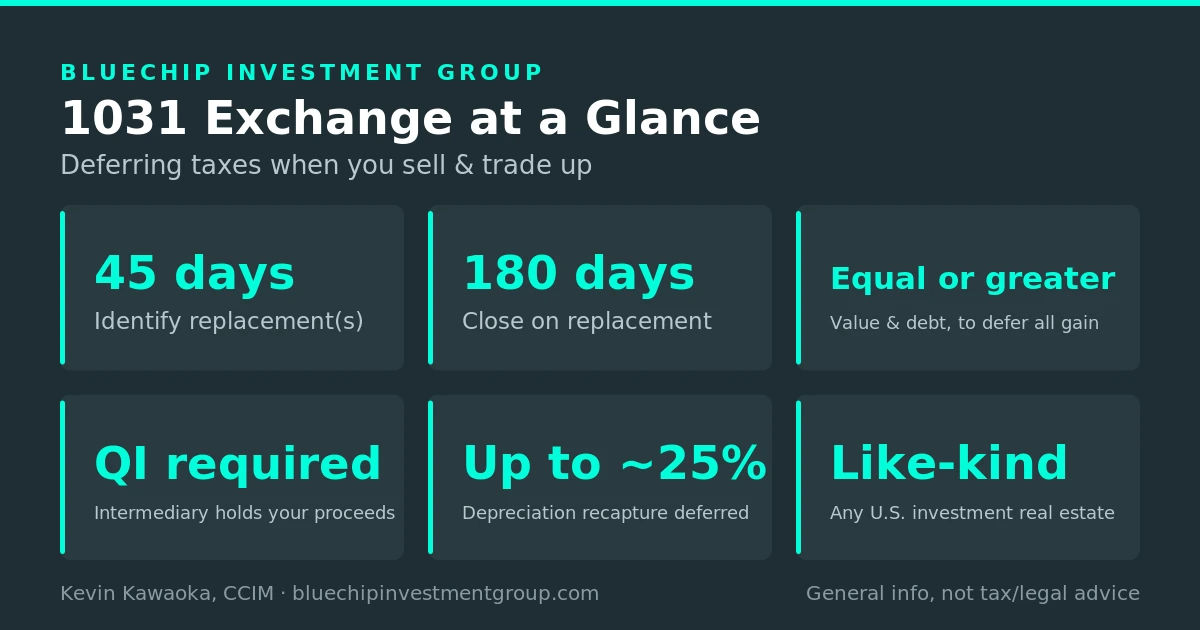
1031 exchange at a glance
45 days: identify replacement property in a signed, written list delivered before day 45.
180 days: close on the replacement within 180 days of your sale, or by your tax return’s due date (including extensions) if that is earlier.
Like-kind: U.S. real estate held for investment or business use, such as an apartment building, retail, industrial or land. Property outside the U.S. is not like-kind, and property held mainly for resale doesn’t qualify.
Identification limits: up to three properties of any value, or more if their total value is no more than 200% of what you sold.
Qualified Intermediary: holds the proceeds, and your right to the money is limited until the exchange is complete.
Boot: cash you keep and debt you don’t replace are taxable. To defer all of the gain, owners reinvest all of the net proceeds and replace the value and debt of what they sold.
What’s deferred: federal capital gains tax (top rate 20%), tax on depreciation (unrecaptured section 1250 gain, up to 25%), the 3.8% net investment income tax, and California income tax, which taxes capital gains as ordinary income.
Why a 1031 exchange matters for Los Angeles apartment owners
Westside apartment owners often hold their buildings for decades, so the gain and the depreciation taken can be large. Tight supply and steady renter demand keep values high in Brentwood, Westwood, West LA, Mar Vista, Palms, Venice, Century City and Beverlywood, and in the separate cities of Santa Monica, Beverly Hills and Culver City. A 1031 exchange lets you sell, reposition and keep your full equity compounding instead of sending a share of it to taxes.
Common Los Angeles moves include trading an older RSO building into a newer one with fewer rent limits, splitting one large building into two in different markets, and trading a management-heavy building into a simpler asset.
How Measure ULA and transfer taxes affect a Los Angeles 1031 exchange
Transfer taxes are paid at closing, so they come out of the sale before your proceeds reach the Qualified Intermediary. In the City of Los Angeles that can be a large number:
City of Los Angeles base tax: 0.45% of the price on sales in the City.
Measure ULA: for closings after June 30, 2026, an added 4% of the full price on sales over $5.4 million and under $10.9 million, and 5.5% at $10.9 million or more. The value includes any loan the buyer assumes, and the thresholds adjust each year.
Los Angeles County documentary transfer tax: $1.10 per $1,000 of value.
For example, on a $6 million sale in the City of Los Angeles, the City’s taxes total 4.45% of the price, or $267,000, plus $6,600 in County tax. That money never reaches your exchange, so plan your replacement purchase around what is left. We model it into your net proceeds before you list, and your CPA confirms how it is treated in the exchange.
Measure ULA applies only inside the City of Los Angeles. Beverly Hills, Culver City and Santa Monica are separate cities where Measure ULA doesn’t apply, and Culver City and Santa Monica charge their own tiered transfer taxes. Our Measure ULA guide for apartment sellers shows how the tax affects pricing near the thresholds. See how we closed a West LA sale ahead of Measure ULA.
RSO buildings in a 1031 exchange
Rent control doesn’t stop a 1031 exchange. An RSO building can be the property you sell or the property you buy. What changes is how it is priced.
Selling an RSO building: buyers underwrite in-place rents against the allowable increase, which is 3% for July 1, 2026 through June 30, 2027 for most City of LA units built on or before October 1, 1978. We price that into your sale and show buyers the building’s upside.
Buying an RSO building: if your replacement property is RSO-covered, plan its income on the allowable increases, and check the address on ZIMAS before you identify it.
Separate cities, separate rules: Santa Monica, Beverly Hills and Culver City each run their own rent programs.
How a Los Angeles 1031 exchange works, step by step
Set it up before you close. Engage a Qualified Intermediary before escrow closes. Once you receive the proceeds yourself, the exchange is lost.
Price the sale net of transfer taxes. In the City of Los Angeles, model Measure ULA and the base tax so you know what you will have to reinvest.
Sell your property. When escrow closes, your 45-day and 180-day clocks both start.
Identify replacements within 45 days. List up to three properties, or more under the 200% rule, in a signed written document delivered before the deadline.
Close within 180 days. Your QI sends the held funds to complete the purchase. The deadline is the earlier of 180 days or your tax return’s due date, including extensions.
Match value and debt. To defer all of the gain, reinvest all of the net proceeds and replace the debt you paid off with new debt or added cash.
Key strategies Westside owners use
Trade up for units and income. Roll years of Westside appreciation into a larger building with stronger, more diversified cash flow.
Split one building into two. Identify two or three replacements so you can trade one large building into smaller ones in different markets and keep a backup on the list.
Use a reverse exchange when you find the replacement first. Under IRS Revenue Procedure 2000-37, an exchange accommodation titleholder can hold the new property before you sell.
Know California’s rule for out-of-state trades. If you exchange California property for property in another state, the Franchise Tax Board requires Form FTB 3840 each year until the deferred California gain is recognized, and California taxes that gain when you later sell.
Build the identification list before you list. The 45-day clock moves fast, so we line up on-market and off-market candidates before your sale closes.
Common mistakes that break a 1031 exchange
Taking the proceeds yourself. The QI must hold the funds, so set it up before closing.
Missing the 45- or 180-day deadline. They are calendar days and run at the same time.
Forgetting the tax return deadline. If your return is due before day 180 and you don’t extend it, your exchange period ends early.
Leaving transfer taxes out of the plan. Measure ULA and the County tax come out at closing and shrink what you can reinvest.
Buying down or pulling cash out. Cash you keep and debt you don’t replace are taxable.
Trading with a related party without planning. If you or the related party sells within two years, the deferred gain generally becomes taxable.
Over-identifying. Listing more than three properties worth more than 200% of your sale can void the identification.
Frequently Asked Questions
What is a 1031 exchange?
A 1031 exchange, named for Internal Revenue Code Section 1031, lets you defer tax on the gain from selling investment real estate by reinvesting the proceeds in other like-kind U.S. real estate through a Qualified Intermediary, within strict deadlines.
What are the 1031 exchange deadlines?
You have 45 days from your sale to identify replacement property in writing, and the earlier of 180 days or your tax return’s due date, including extensions, to close on it. Both clocks start when your sale closes and run at the same time.
Does Measure ULA reduce what I can reinvest in a 1031 exchange?
On larger sales in the City of Los Angeles, yes. For closings after June 30, 2026, Measure ULA adds 4% of the full price on sales over $5.4 million and 5.5% at $10.9 million or more, on top of the City’s 0.45% base tax, and it is paid at closing. We model it into your net proceeds before you list, and your CPA confirms how it is treated in the exchange.
Can I exchange a rent-controlled (RSO) building?
Yes. An RSO building can be the property you sell or the one you buy. Buyers price it on in-place rents and the allowable increase, 3% for July 1, 2026 through June 30, 2027 for most City of LA units built on or before October 1, 1978.
Can I 1031 from Los Angeles into the South Bay or another state?
Yes. Any U.S. investment real estate is like-kind, so Westside owners can trade into the South Bay or out of state. If the new property is outside California, the Franchise Tax Board requires Form FTB 3840 each year until the deferred California gain is recognized.
Do I need a Qualified Intermediary?
Yes. A Qualified Intermediary holds your sale proceeds and completes the purchase, and your right to the money is limited until the exchange is done. If you take the proceeds yourself, the exchange fails.
How much tax can a 1031 exchange defer?
Potentially all of the tax on your gain: federal capital gains tax (top rate 20%), up to 25% on depreciation you’ve taken, the 3.8% net investment income tax, and California income tax. The amount depends on your basis, depreciation and bracket, so confirm it with your CPA. It is deferral, not forgiveness.
Thinking about a 1031 exchange in Los Angeles?
Kevin Kawaoka, CCIM, a Westside apartment broker with Bluechip Investment Group, helps Los Angeles owners plan the sale and the exchange together. Kevin + Team bring CCIM-certified, institutional-grade underwriting, price your building net of Measure ULA and transfer taxes, source on-market and off-market replacements, and coordinate with your Qualified Intermediary and CPA so the deadlines are met. Request a free, confidential valuation, see our Los Angeles overview, or get in touch.
General information only and not tax, legal, or accounting advice. 1031 exchange rules (deadlines, identification rules, like-kind and value requirements, and tax rates) are technical and change over time, and outcomes depend on your specific facts. Consult a Qualified Intermediary and your CPA or attorney before starting an exchange. Sources: IRS Form 8824 instructions, Treasury Regulation 1.1031(k)-1, IRS Topic 409, IRS net investment income tax guidance, California Franchise Tax Board, City of Los Angeles Office of Finance, Los Angeles County Registrar-Recorder, and LAHD.