Selling a South Bay apartment building can trigger a large tax bill — federal capital gains, the 3.8% net investment income tax, depreciation recapture (taxed up to 25%), and California state tax (up to 13.3%). A 1031 exchange lets you defer all of it by rolling your sale proceeds into another investment property, so your full equity keeps working for you instead of going to taxes. This guide explains how it works, the strategies South Bay owners use, and the mistakes that blow up an exchange.
(General information only — not tax or legal advice. 1031 rules are technical and your situation is specific; work with a qualified intermediary and your CPA/attorney before acting.)
The short answer
A 1031 exchange lets you defer (not erase) capital gains and depreciation-recapture taxes when you sell an investment property and reinvest the proceeds into “like-kind” real estate of equal or greater value. You have 45 days from your sale to identify replacements and 180 days to close, and a Qualified Intermediary (QI) must hold the funds — you can’t touch the proceeds. For South Bay owners sitting on years of appreciation, it’s the single most powerful tool to trade up (often from a single-family or small rental into a 5–100+ unit apartment building) without losing a chunk of equity to taxes today.
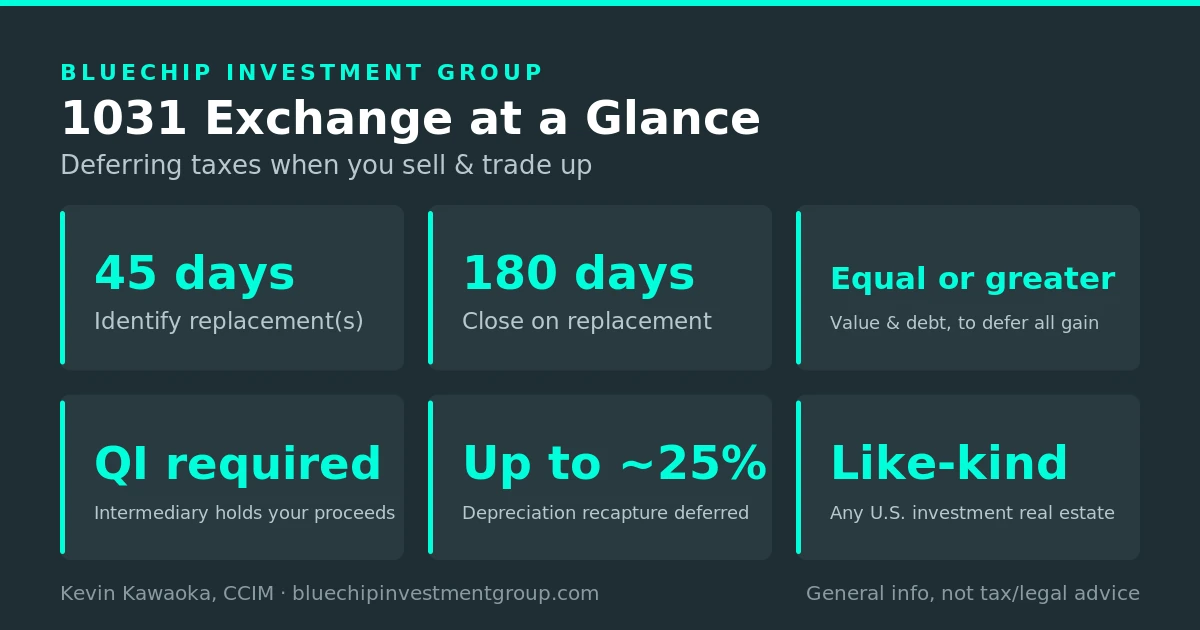
1031 exchange at a glance
- 45-day rule: identify replacement property(ies) within 45 days of closing your sale.
- 180-day rule: close on the replacement within 180 days of the sale.
- Like-kind: virtually any U.S. real property held for investment qualifies (an apartment building, retail, land, etc.).
- Equal-or-greater rule: to defer 100% of the gain, buy equal or greater in both value and debt, and reinvest all the equity.
- Qualified Intermediary: required — the QI holds proceeds; if you take receipt of the cash, the exchange fails.
- What’s deferred: federal capital gains, 3.8% NIIT, depreciation recapture (up to 25%), and California state tax — deferred, potentially indefinitely if you keep exchanging (and stepped up for heirs at death).
Why a 1031 exchange matters for South Bay owners
The South Bay — Torrance, Gardena, Redondo Beach, Hermosa Beach, Manhattan Beach, Lawndale, Lomita, El Segundo, Inglewood, Carson, San Pedro, Wilmington, and the Palos Verdes Peninsula — is one of California’s most appreciated rental markets. Many owners bought years ago and are sitting on substantial equity. Selling outright can send a meaningful share of that gain to taxes; a 1031 exchange lets you sell now, trade up, and keep your full equity compounding in a larger or higher-performing asset.
A common South Bay move: roll a long-held single-family rental or duplex into a 5–10+ unit apartment building, increasing monthly income and spreading tenant risk — all on a tax-deferred basis.
How a South Bay 1031 exchange works, step by step
- Set it up before you close. Engage a Qualified Intermediary before your sale closes — once you receive the proceeds, you’ve disqualified the exchange.
- Sell your property. When escrow closes, your 45-day identification clock and 180-day closing clock both start.
- Identify replacements (within 45 days). Use the Three-Property Rule (identify up to three, any value) or the 200% Rule (more than three, total value ≤ 200% of what you sold).
- Go under contract & close (within 180 days). Your QI wires the held funds to complete the purchase, keeping you IRS-compliant.
- Match value and debt. To defer the entire gain, the replacement should be equal or greater in price and debt, with all equity reinvested.
Key strategies South Bay investors use
- Trade up for units and income. Convert appreciation in a small property into a larger apartment building with stronger, more diversified cash flow.
- Leverage South Bay appreciation. Equity that’s been sitting idle in a low-yield asset can be redeployed into a higher-performing one — tax-deferred.
- Use a reverse exchange when inventory is tight. If you find the right replacement before selling, a reverse exchange lets you buy first and sell second — useful in a competitive, low-inventory market like the South Bay.
- Consider a balance of yield and location. Some investors pair a premium South Bay hold with a higher-cash-flow asset elsewhere; we help model the trade-offs so the exchange fits your goals (and your QI/CPA confirm the mechanics).
- Plan the identification list early. The 45-day clock is unforgiving — line up candidates (including off-market options) before you close.
Common mistakes that break a 1031 exchange
- Taking receipt of the proceeds. Even briefly touching the funds voids the exchange — the QI must hold them.
- Missing the 45- or 180-day deadline. They’re calendar days, include weekends/holidays, and are essentially never extended. Start the search early.
- Buying down in value or pulling cash out. Any value/debt shortfall or cash taken (“boot”) is taxable.
- Underestimating closing costs. Factor LA County transfer taxes, title, escrow, and lender fees into the math.
- Starting the replacement search too late. Inventory moves fast; identify before you sell.
Frequently Asked Questions
What is a 1031 exchange?
A 1031 exchange (named for IRS Code Section 1031) lets an investor defer capital gains and depreciation-recapture taxes by selling an investment property and reinvesting the proceeds into like-kind investment real estate of equal or greater value, using a Qualified Intermediary, within strict deadlines.
What are the 1031 exchange deadlines?
You have 45 days from the sale closing to identify replacement property in writing, and 180 days from the sale to close on it. Both run concurrently and are calendar days; missing either generally fails the exchange.
How much tax can a 1031 exchange defer?
Potentially a large share of your gain — federal capital gains (typically 15–20%), the 3.8% net investment income tax, depreciation recapture (up to 25%), and California tax (up to 13.3%). The exact amount depends on your basis, depreciation taken, and tax bracket, so confirm the figure with your CPA. Remember it’s deferral, not forgiveness — though continued exchanging (and a step-up in basis for heirs) can defer it indefinitely.
Do I need a Qualified Intermediary?
Yes. The IRS requires a QI to hold the sale proceeds and facilitate the exchange. If you take possession of the funds at any point, the exchange is disqualified. QI fees are modest relative to the taxes deferred.
Can I 1031 into a bigger apartment building in the South Bay?
Yes — trading up from a single-family rental, duplex, or small building into a larger 5–100+ unit South Bay apartment building is one of the most common and effective uses, increasing income and diversifying tenant risk on a tax-deferred basis.
Thinking about a 1031 exchange in the South Bay?
Bluechip Investment Group, led by Kevin Kawaoka, CCIM, helps South Bay apartment owners plan and execute 1031 exchanges end to end — pricing your sale, sourcing replacement and off-market opportunities, and coordinating with your Qualified Intermediary and CPA so the deadlines and value rules are met. For a clear read on your equity and options, request a free, confidential valuation, see our South Bay apartment broker page, or get in touch.
Related: South Bay Apartment Broker · How Much Is My Apartment Building Worth? · AB 1482 & South Bay Rent Control Explained · How to Sell an Apartment Building in Torrance
General information only and not tax, legal, or accounting advice. 1031 exchange rules (deadlines, identification rules, like-kind and value requirements, and tax rates) are technical and change over time; outcomes depend on your specific facts. Consult a Qualified Intermediary and your CPA or attorney before initiating an exchange.