It’s the first question almost every owner asks, and the honest answer is: your apartment building is worth what its income can justify to a buyer in today’s market — not what you paid, not the county’s assessed value, and not what an automated website spits out in three seconds. Understanding how that number is actually built is the difference between pricing your building right and either leaving money on the table or sitting on the market while you chase a number buyers won’t pay.
This guide explains how brokers and buyers really value multifamily property in the South Bay and across Los Angeles — the income math, the cross-checks, and the levers that move your number up or down — so you can read your own building the way the market does.
The short answer: apartment buildings are valued on income
Unlike a single-family home, which is priced mostly on comparable sales and emotion, an apartment building is priced primarily on the income it produces. The core formula is simple:
Value = Net Operating Income (NOI) ÷ Cap Rate
Net Operating Income (NOI) is your annual gross income minus operating expenses — property taxes, insurance, utilities, management, maintenance, and reserves. It does not subtract your mortgage payment or depreciation; buyers want to see the building’s performance independent of how you happen to finance it.
The capitalization (cap) rate is the return the market currently demands for that income stream. Divide your NOI by the prevailing cap rate and you get value. The critical insight: because you’re dividing by a small number, small changes in NOI produce large changes in value. At a 5% cap rate, every extra $10,000 of annual NOI adds roughly $200,000 to your building’s value. That’s why how your income is presented matters so much.
Cap rates: what they are and where they sit today
A lower cap rate means a higher price for the same income — it signals buyers see the asset as lower-risk and will accept a smaller return to own it. Cap rates are driven by location, building age and condition, perceived risk, the lending environment, and rent-growth potential.
In the current market, based on Bluechip’s analysis of recent South Bay and Los Angeles multifamily sales:
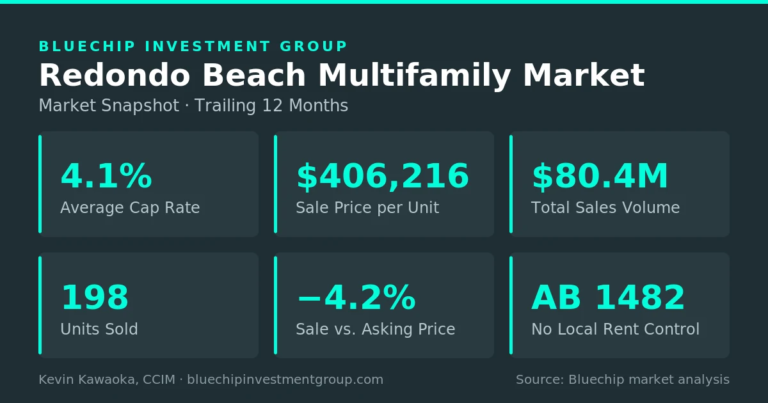
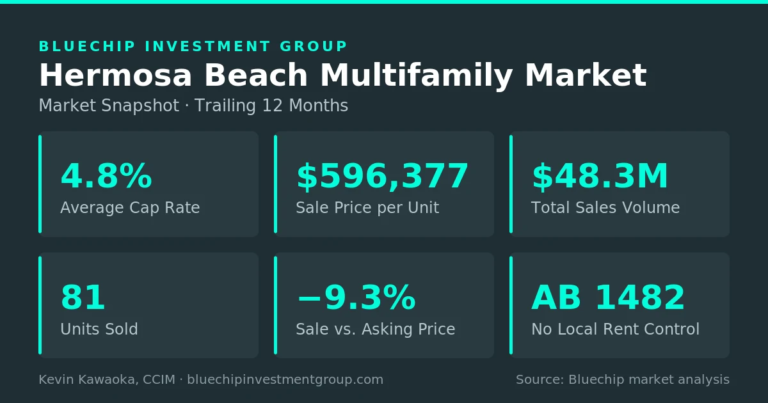
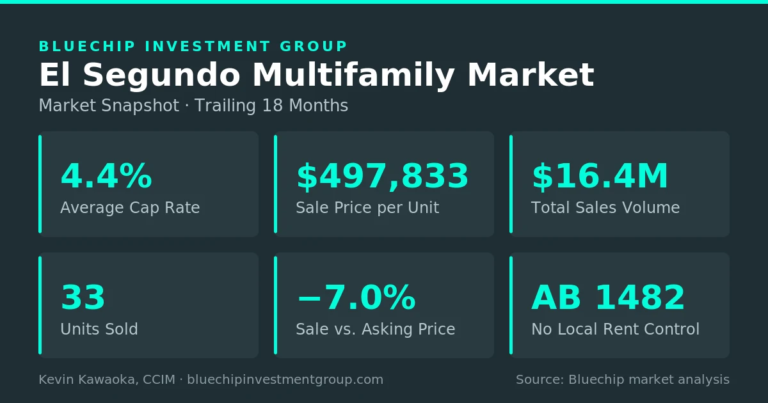
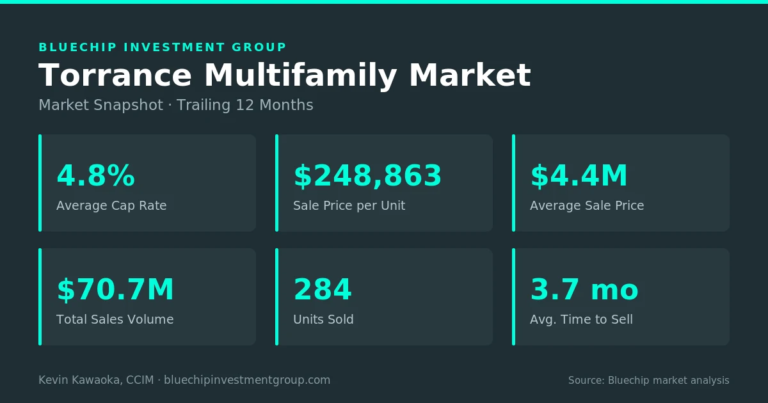
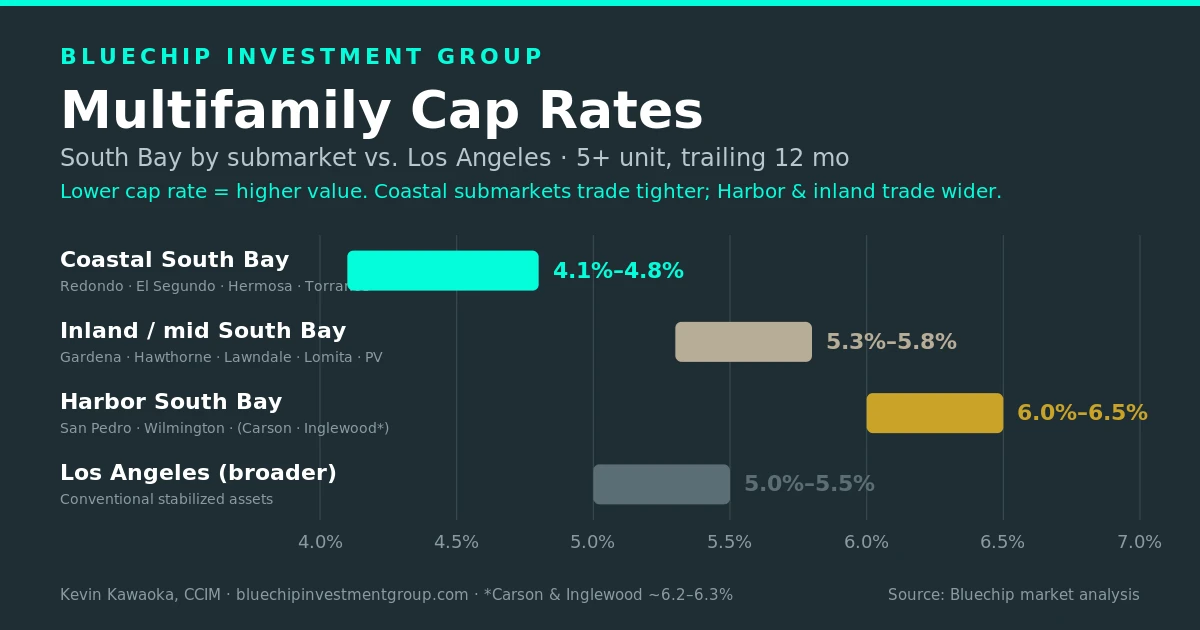
- Coastal South Bay — Redondo Beach, El Segundo, Hermosa Beach, and Torrance — trades at the tightest cap rates, roughly 4.1% to 4.8%, among the most seller-favorable in the county.
- Inland and mid–South Bay — Gardena, Hawthorne, Lawndale, Lomita, and the Palos Verdes cities — generally sits around 5.3% to 5.8%.
- Harbor South Bay — San Pedro and Wilmington — trades wider, roughly 6.0% to 6.5% (Carson and Inglewood run about 6.2%–6.3%), reflecting local rent control and tenant profile.
- The broader Los Angeles market generally sits a bit higher, around 5.0% to 5.5% for stabilized mid-tier assets.
- In Torrance specifically, sales over the trailing 12 months averaged about a 4.8% cap rate — among the most seller-favorable in the region.
The coastal South Bay’s tight cap rates reflect how supply-constrained and sought-after those submarkets are: buyers pay more per dollar of income there than almost anywhere in LA County. Cap rates widen as you move inland and into the Harbor communities, partly because of local rent control. (Ranges reflect Bluechip’s market analysis and are for context; your building’s actual cap rate depends on its specifics.)
The other lenses buyers use
Cap rate is the primary tool, but no experienced buyer relies on a single number. They cross-check value against:
- Gross Rent Multiplier (GRM) — the price divided by gross annual rent. A fast screen for comparing buildings before digging into expenses. A lower GRM generally signals a better value relative to rent.
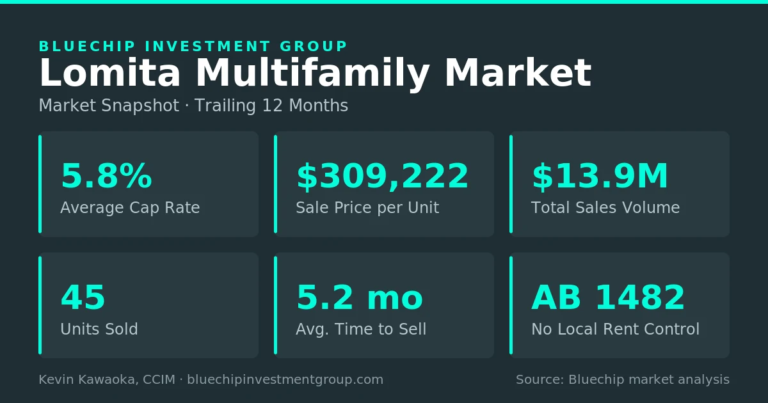
- Price per unit — what comparable buildings have sold for on a per-door basis. In Torrance, for example, buildings traded around $248,863 per unit over the trailing 12 months — a real-world benchmark a buyer will measure your building against.
- Price per square foot — useful for comparing buildings with different unit mixes, and a key input where land or redevelopment value is in play (common in the beach cities).
A credible valuation reconciles all of these — cap rate, GRM, price per unit, and price per square foot — against genuinely comparable recent sales, not a generic county-wide average.
Rent upside: the lever that moves your number most
Here’s what separates a flat valuation from a competitive one: the gap between your in-place rents and current market rents. Buyers — especially the value-add operators who dominate today’s South Bay buyer pool — aren’t just paying for the income your building produces now; they’re underwriting where that income can realistically go. A building with rents 20% under market, documented unit by unit, will draw stronger offers than an identical building where that upside is merely asserted.
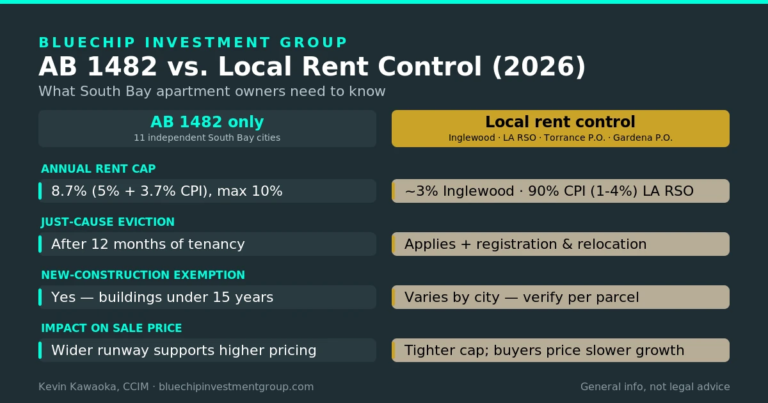
This is also where Los Angeles regulation becomes a pricing factor. In the City of LA, most older buildings fall under the Rent Stabilization Ordinance (RSO), which sharply limits how quickly a buyer can move rents toward market — capping the realizable upside. In non-RSO South Bay cities like Torrance, Gardena, and Carson, buildings follow only the statewide AB 1482, a far more workable framework. That’s a real reason well-located South Bay buildings command tighter cap rates and higher prices: the upside is more reachable. (We confirm the specific regulatory framework for any building at valuation, since it materially affects value.)
What raises — and lowers — your value
Raises it: below-market rents with documented room to grow; a desirable submarket and location; strong, clean financials; a good unit mix; minimal deferred maintenance; and a favorable regulatory profile (non-RSO).
Lowers it: rents already at or above market (little upside left); deferred maintenance and capital needs; high or poorly documented expenses; a tough regulatory overlay; and a weak rent roll with no story. Many of these are fixable before listing — which is exactly why an honest pre-sale valuation pays for itself.
Why an instant online estimate misses (and a broker valuation doesn’t)
Automated “what’s my building worth” tools apply a generic cap rate to rough income and call it a day. They can’t see your actual rent roll, your real upside, the condition of the property, the micro-trends in your specific submarket, or who’s actually buying right now and what they’ll pay. For a single-family home, an algorithm is a reasonable starting point. For a multifamily asset — where value swings six figures on small NOI and upside differences — it’s a guess.
A broker’s opinion of value (BOV) is built from your real numbers, genuinely comparable recent sales, the current buyer pool, and the regulatory reality of your specific building. It’s the difference between a guess and a number you can actually price and sell on. If you want one for your building, you can request a free, no-obligation valuation here — we’ll build it from real comps and your rent roll.
Common valuation mistakes owners make
- Anchoring to what you paid. The market doesn’t care about your basis; it cares about today’s income and cap rate.
- Using the assessed value. County assessments are for taxes, not market value, and are usually well off.
- Ignoring upside. Undocumented below-market rents leave real money on the table.
- Trusting an instant estimate. It can be off by hundreds of thousands either way.
- Forgetting the regulatory factor. RSO vs. AB 1482 status materially changes what a building is worth.
Frequently Asked Questions
How are apartment buildings valued?
Primarily on income: Net Operating Income divided by the market cap rate, then cross-checked against GRM, price per unit, and price per square foot from comparable recent sales — and adjusted for rent upside.
What’s a good cap rate in the South Bay right now?
It depends on the submarket. Based on Bluechip’s analysis, coastal South Bay buildings (Redondo Beach, El Segundo, Hermosa Beach, Torrance) have recently traded around 4.1%–4.8% — tighter than the broader LA market (roughly 5.0%–5.5%) — while inland markets run about 5.3%–5.8% and the Harbor communities (San Pedro and Wilmington) about 6.0%–6.5%. Lower cap rates mean higher values.
What’s the difference between cap rate and GRM?
Cap rate is based on net income (after operating expenses); GRM is based on gross rent (before expenses). GRM is a quick screen; cap rate is the more complete measure.
Is an online “instant valuation” accurate for apartment buildings?
Not reliably. Multifamily value depends on your specific rent roll, upside, condition, submarket, and regulatory status — things an algorithm can’t see. A broker valuation is far more accurate.
How do I get my apartment building valued?
Request a free, confidential valuation — no obligation. We review comps, your rent roll, and the upside to give you a realistic number.
Find out what your building is worth
Bluechip Investment Group, led by Kevin Kawaoka, CCIM, values and sells multifamily across the South Bay and Los Angeles — buildings from 5 to 100+ units. For a clear, honest read on your building’s value in today’s market, request a free, confidential valuation. No pressure, no obligation — just the real number and the reasoning behind it.
Related: South Bay Apartment Broker · How to Sell an Apartment Building in Torrance · Free Apartment Valuation