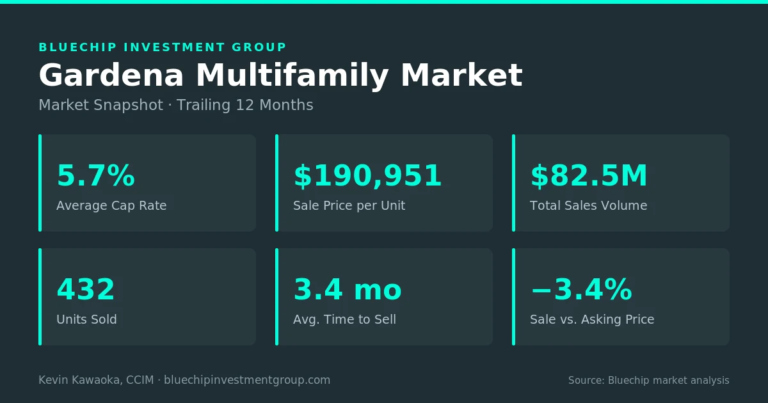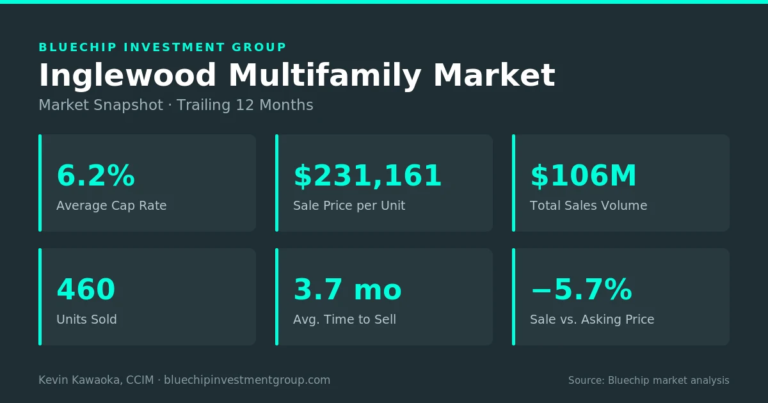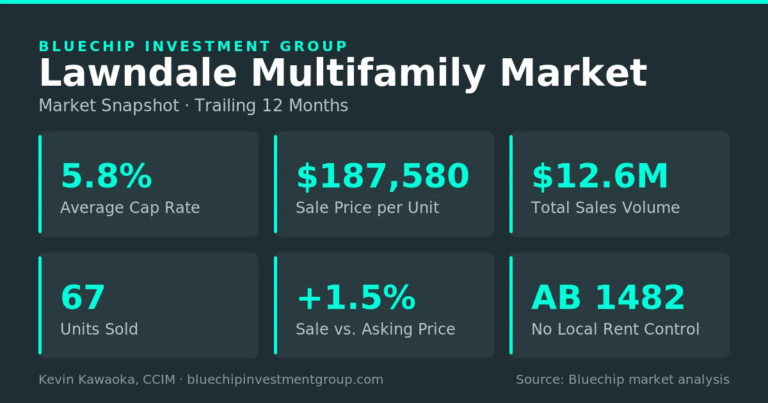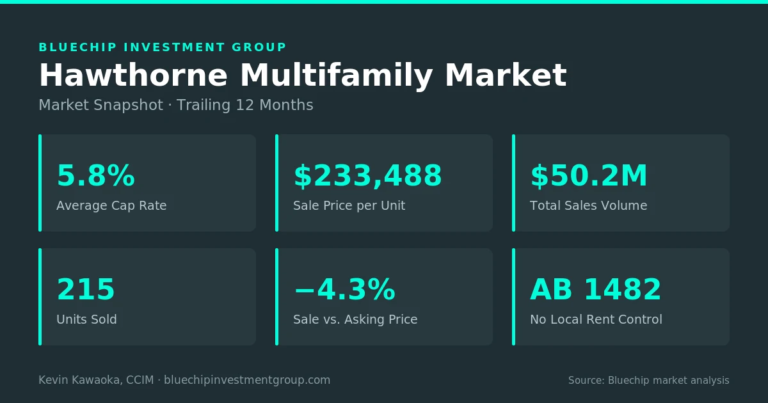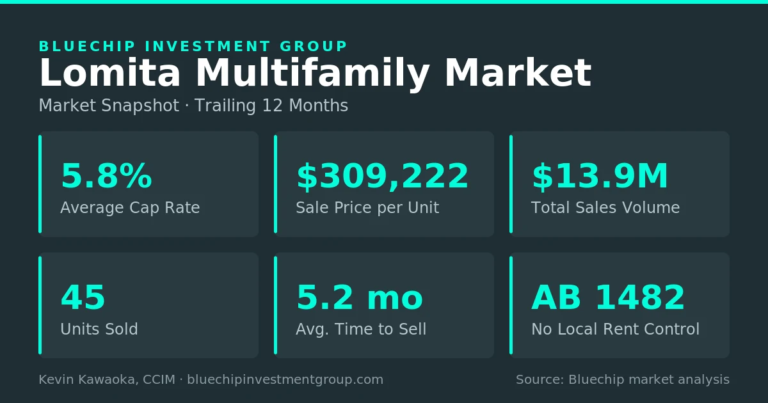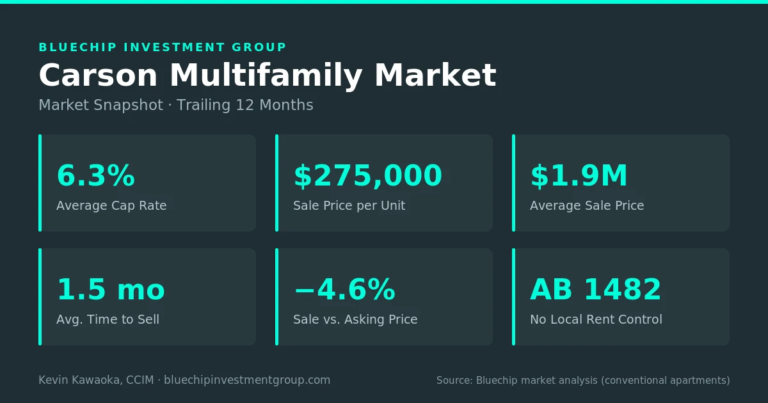
If you own apartments in the South Bay or greater Los Angeles, two layers of rent regulation can apply to your building: California’s statewide AB 1482 (the Tenant Protection Act) and, in some cities, a stricter local rent-control ordinance on top of it. Knowing which applies — and how much you can actually raise rents — matters for day-to-day operations and, when you sell, for the price a buyer will pay. This guide lays out the current 2026 numbers, the exemptions, and a city-by-city breakdown of where local rent control is and isn’t in play across the South Bay.
(This is general information, not legal advice. Caps, exemptions, and local ordinances change; confirm the current rules for your specific building before relying on them.)
The short answer (2026)
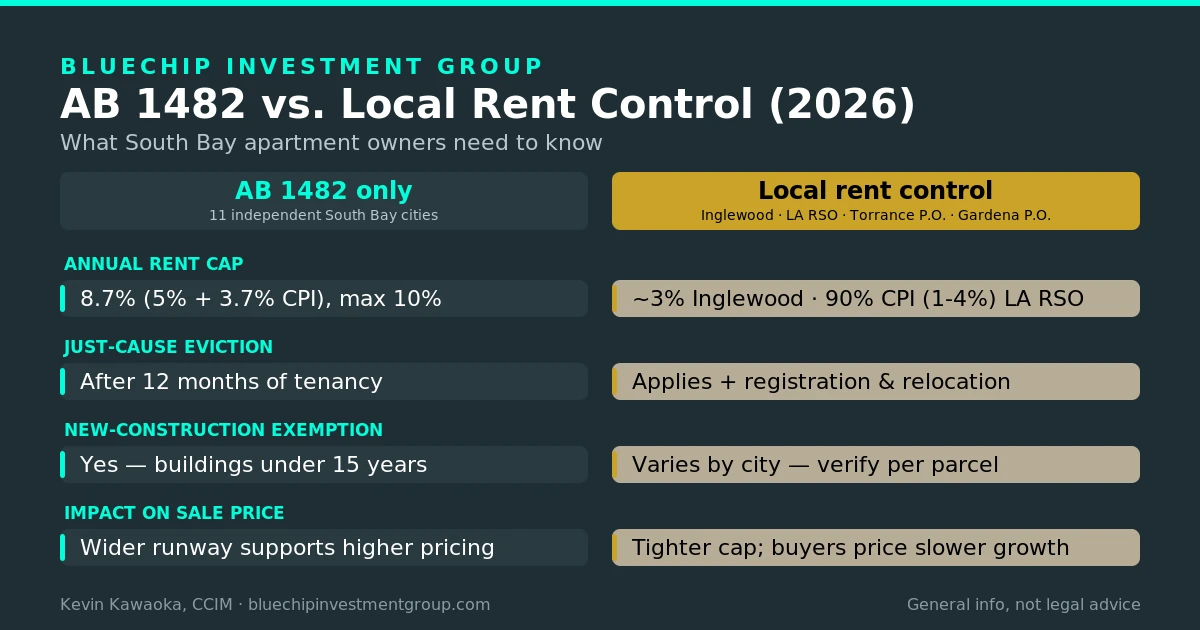
For most apartment buildings in the Los Angeles area, AB 1482 caps annual rent increases at 8.7% for the period August 1, 2026 through July 31, 2027 — that’s 5% plus the regional CPI (3.7%), and never more than 10%. Just-cause eviction protections apply after a tenant has been in place 12 months. But several South Bay cities are not covered by a local ordinance and follow AB 1482 only, while a few — Inglewood, the City of Los Angeles (including San Pedro and Wilmington), and unincorporated LA County areas — layer on their own, lower caps.
- AB 1482 cap (LA region, Aug 2026–Jul 2027): 8.7% (5% + 3.7% CPI), max 10%
- Just-cause eviction: applies after 12 months of tenancy
- Generally covered: apartment buildings 15+ years old
- Local rent control (stricter) in the South Bay: Inglewood; City of LA / RSO (San Pedro, Wilmington); unincorporated LA County (RSTPO)
What is AB 1482?
AB 1482, California’s Tenant Protection Act of 2019, sets a statewide ceiling on annual rent increases and requires “just cause” to end most tenancies. The annual cap is 5% plus the regional Consumer Price Index (CPI), capped at 10% in any 12-month period. For the Los Angeles–Long Beach–Anaheim region, the CPI figure measured in spring 2026 was 3.7%, putting the cap at 8.7% from August 1, 2026 through July 31, 2027. The percentage resets each year when the new CPI is published.
Two practical rules that trip owners up: you generally can’t raise rent more than twice in 12 months, and the combined increases can’t exceed the cap. After a tenant has lived in the unit 12 months, just-cause protections apply — meaning you need a legally recognized reason (and, for “no-fault” reasons like an owner move-in or substantial remodel, often relocation assistance) to end the tenancy.
What’s exempt from AB 1482?
Not every property is covered. Common exemptions include:
- New construction — buildings with a certificate of occupancy issued within the last 15 years (a rolling exemption).
- Most single-family homes and condos, if the owner isn’t a corporation/REIT/LLC with a corporate member — and the required exemption notice has been given.
- Owner-occupied duplexes where the owner lives in one unit.
- Properties already under a stricter local ordinance — in that case the local rules govern (you follow the most restrictive that applies).
Even exempt units typically still owe the just-cause and notice pieces in many cases, so don’t assume “exempt from the cap” means “exempt from everything.”
AB 1482 vs. local rent control — the key distinction
AB 1482 is the floor. A city can impose its own, stricter ordinance, and where one exists you must follow the more restrictive rule. In the South Bay, that distinction splits cleanly:
- AB 1482 only (no local ordinance): the independent cities — Torrance, Gardena, Lawndale, Hawthorne, Carson, Redondo Beach, Lomita, Hermosa Beach, Manhattan Beach, El Segundo, and the Palos Verdes cities. Here, owners have the full 8.7% runway.
- Local rent control (stricter):
- Inglewood — its own Housing Protection ordinance caps increases on 5+ unit buildings near 3% a year (smaller buildings higher), plus just-cause.
- City of Los Angeles (RSO) — covers LA-city neighborhoods including the Harbor communities of San Pedro and Wilmington. Units with a certificate of occupancy on or before October 1, 1978 are capped at 3% through June 30, 2026, then a new formula of 90% of CPI (1%–4%) starting July 1, 2026, plus registration, just-cause, and relocation rules.
- Unincorporated LA County (RSTPO) — small pockets near the Peninsula and elsewhere fall under the County’s ordinance rather than AB 1482 alone.
Don’t trust the mailing address. A property’s mailing city isn’t always its legal jurisdiction — and this one catches owners and agents off guard. Notably, some addresses in the “Torrance” and “Gardena” postal areas (Torrance P.O. and Gardena P.O.) are legally within the City of Los Angeles, so they fall under the LA City RSO, not AB 1482 — despite carrying a Torrance or Gardena mailing address. Always verify a building’s actual jurisdiction (via city/county GIS or assessor records), not the city on the envelope, before relying on which rent rules apply. Getting this wrong can materially mis-state a building’s reachable rent upside and its value.
Why rent regulation affects what your building is worth
When you sell, a buyer isn’t just paying for today’s income — they’re underwriting how quickly they can move rents toward market. That “reachable upside” is exactly what rent regulation governs:
- In a no-local-control city (Torrance, Gardena, the beach cities, etc.), a buyer can underwrite moving below-market rents up under AB 1482’s wider runway — which supports a higher price for the same in-place income.
- In a rent-controlled city (Inglewood, San Pedro/Wilmington under the LA RSO), that path is capped tightly — so a buyer prices in slower rent growth, and the building has to be priced and positioned with the ordinance built into the math.
This is why two otherwise-identical buildings can be worth meaningfully different amounts a few miles apart — and why pricing a building correctly means knowing exactly which rules apply. (Want a read on your building? Request a free, no-obligation valuation.)
South Bay rent control, city by city
For a deeper, data-backed look at selling in your specific market — pricing, the local rent rules, and the buyer pool — see our city guides:
- AB 1482 only: Torrance · Gardena · Hawthorne · Lawndale · Carson · Redondo Beach · Lomita · Hermosa Beach · El Segundo · Palos Verdes
- Local rent control: Inglewood (local ~3% cap) · San Pedro & Wilmington (City of LA RSO)
Frequently Asked Questions
How much can I raise rent in California in 2026?
Under AB 1482, in the Los Angeles region the cap is 8.7% for August 1, 2026 through July 31, 2027 (5% + 3.7% CPI, never more than 10%). If your building is in a city with a stricter local ordinance (e.g., Inglewood, or the City of LA including San Pedro and Wilmington), the lower local cap applies instead.
What is the AB 1482 rent cap for 2026?
8.7% for the LA–Long Beach–Anaheim region for the August 2026–July 2027 period. The figure is 5% plus regional CPI (3.7% this period), capped at 10%, and it resets annually.
Which South Bay cities have rent control?
Inglewood has its own ordinance (about 3% on 5+ unit buildings). The City of Los Angeles RSO covers the Harbor communities of San Pedro and Wilmington (older buildings capped at 3%, moving to a 90%-of-CPI / 1%–4% formula from July 2026). Unincorporated LA County areas fall under the County’s RSTPO. The independent cities — Torrance, Gardena, Hawthorne, Lawndale, Carson, Redondo Beach, Lomita, Hermosa Beach, Manhattan Beach, El Segundo, and the Palos Verdes cities — have no local ordinance and follow AB 1482 only.
Are “Torrance P.O.” and “Gardena P.O.” under rent control?
Often, yes. Properties in the Torrance and Gardena postal areas known as Torrance P.O. and Gardena P.O. are legally within the City of Los Angeles, so they fall under the LA City Rent Stabilization Ordinance (RSO) — not just AB 1482 — even though they use a Torrance or Gardena mailing address. Always confirm a building’s actual jurisdiction before assuming the incorporated city’s rules apply.
Is my building exempt from AB 1482?
Possibly — common exemptions include buildings less than 15 years old, many single-family homes/condos not owned by a corporation, and owner-occupied duplexes. But properties under a stricter local ordinance follow those local rules. Confirm your specific building’s status before relying on an exemption.
Does rent control affect my building’s value?
Yes. Buyers price the reachable rent upside, which rent control caps. A building in a no-local-control city generally supports a higher price than an otherwise-identical building under a local ordinance, because the buyer can underwrite faster movement toward market rents.
Thinking about selling — and want to know how the rules affect your price?
Bluechip Investment Group, led by Kevin Kawaoka, CCIM, specializes in South Bay and greater Los Angeles multifamily and prices every building with the exact rent-regulation framework built into the analysis — so you don’t leave money on the table or scare off buyers with an unrealistic number. Request a free, confidential valuation, see our South Bay apartment broker page, or get in touch.
Related: South Bay Apartment Broker · How Much Is My Apartment Building Worth? · Free Apartment Valuation
General information only, not legal advice. AB 1482 caps reset annually with CPI, and local ordinances, exemptions, and just-cause/relocation rules change by period and property type. Confirm the current rules for your specific building with the applicable city/county or qualified counsel before relying on them.