Selling an apartment building on the Palos Verdes Peninsula is a niche within a niche. PV is one of Southern California’s most affluent and supply-constrained areas — overwhelmingly single-family, with very little multifamily. What apartment stock exists skews toward a small number of larger, institutional-grade communities, and they trade rarely. When they do, they command premium per-unit pricing and attract institutional and high-net-worth capital that specifically wants a foothold on the Peninsula. Pricing one of these assets is a specialized exercise — far closer to institutional underwriting than to selling a typical small building.
This guide covers how Palos Verdes is pricing apartment communities, why its regulatory profile helps, who’s buying, and what the process looks like from the decision to sell through close.
Palos Verdes apartment market at a glance (trailing 18 months)
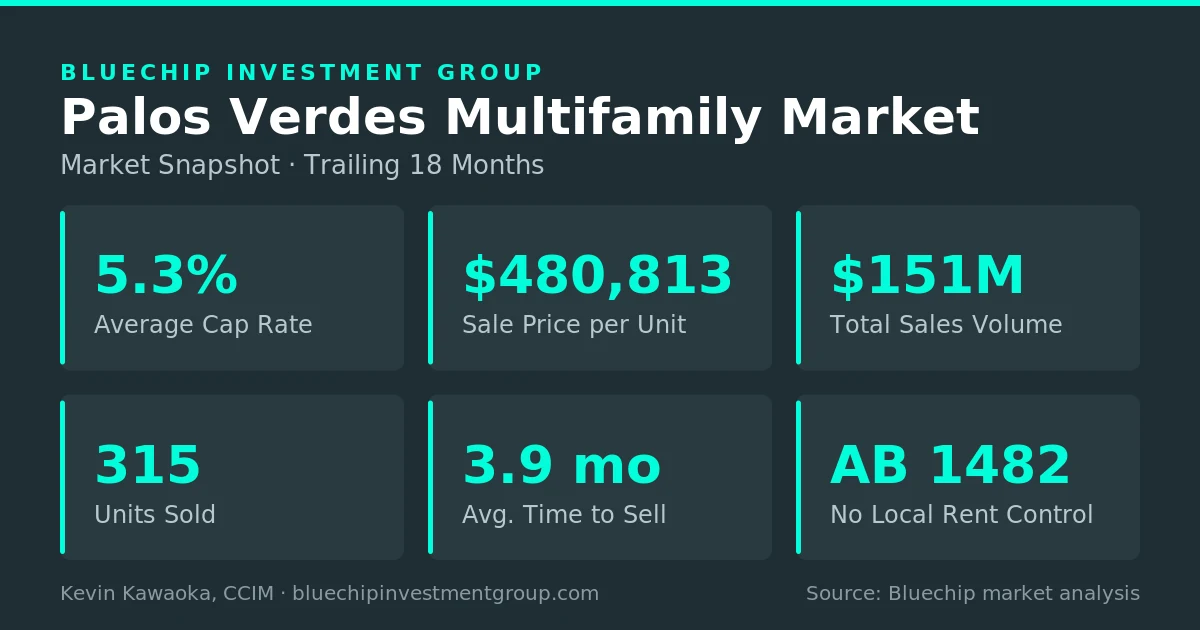
Palos Verdes is a scarce, premium, institutional-leaning apartment market. Over the trailing 18 months just 3 apartment communities traded on the Peninsula — about $151M across 315 units — but the headline is the consistency of pricing: per-unit values clustered tightly at roughly $417,500–$494,163 (averaging about $480,813, among the highest per-unit pricing in the South Bay) at a ~5.3% average cap rate (median 5.2%). One large ~257-unit, $127M community sale skews the dollar averages, so the median deal (~$20M, 48 units) is the more representative middle. The incorporated PV cities have no local rent control (only statewide AB 1482).
- Apartment communities sold: 3 (trailing 18 months)
- Average cap rate: ~5.3% (median 5.2%; range 4.3%–6.4%)
- Average price per unit: ~$480,813 (tight range: $417,500–$494,163)
- Median sale: ~$20M across 48 units
- Total volume: ~$151M across 315 units (one ~257-unit sale ≈ 84% of volume)
- Average time to sell: ~3.9 months
(Figures reflect Bluechip’s analysis of Palos Verdes apartment-community sales over the trailing 18 months — a very small, institution-weighted sample. The dollar averages are skewed by a single large transaction; per-unit pricing and cap rate are the more reliable read. Treat as directional and ask us for a building-specific valuation.)
The Palos Verdes market
The Peninsula — Rancho Palos Verdes, Palos Verdes Estates, Rolling Hills, and Rolling Hills Estates — is defined by hillside, ocean-view living, top-rated schools, and strict low-density zoning. That makes apartment product genuinely rare: most multifamily is concentrated in a handful of larger communities, primarily in Rancho Palos Verdes. So the “market” isn’t a steady flow of small-building trades; it’s the occasional sale of a sizable community to institutional or high-net-worth capital.
The trailing-18-month data shows exactly that pattern: 3 sales, ranging from a 10-unit building to a 257-unit community, but with remarkably consistent per-unit pricing (about $417,500–$494,163) and cap rates around 5.2–5.3%. For a seller, the implications are specific: value is driven by the Peninsula’s prestige, scarcity, and the depth of buyers who want institutional-quality coastal product — and pricing leans on per-unit and per-square-foot benchmarks plus the limited local comps, not on a thick set of recent sales. (One caveat worth noting: across these few deals, sale prices came in well below original asking on average — heavily influenced by the single largest transaction — which is exactly why disciplined, comp-based pricing matters so much in a thin, high-dollar market.)
Palos Verdes’s rent-regulation profile
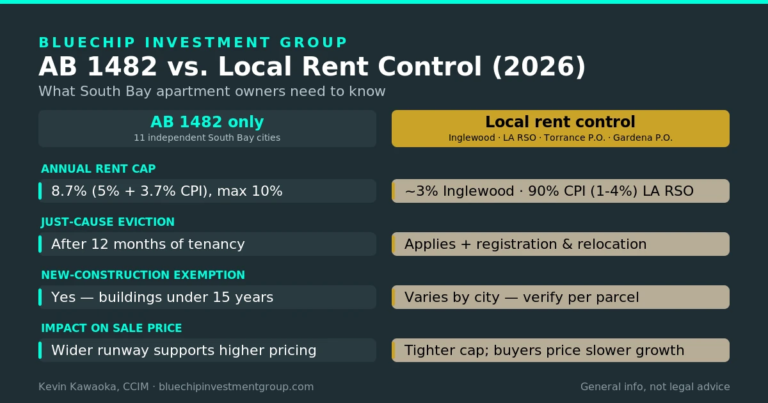
The four incorporated Palos Verdes cities — Rancho Palos Verdes, Palos Verdes Estates, Rolling Hills, and Rolling Hills Estates — have no local rent-control ordinance; apartments there follow only California’s statewide AB 1482 (5% + regional CPI, roughly 8.7% for the 2026 period; just-cause after 12 months; buildings 15+ years old). One nuance specific to the Peninsula: there are small unincorporated Los Angeles County pockets nearby, and properties in those areas fall under the LA County rent ordinance (RSTPO) rather than AB 1482 alone. For buyers paying a premium for scarce Peninsula product, the incorporated cities’ lighter profile supports pricing — and confirming exactly which framework applies is part of the work. (We verify the applicable rules for your specific property at listing.)
How buyers value a Palos Verdes community
In a scarce, institution-leaning market, buyers weigh:
- Price per unit and price per square foot — the most reliable benchmarks here, given how few and how varied the trades are.
- Cap rate — around 5.2–5.3% across recent sales, reflecting premium, stabilized coastal product.
- Land, location, and prestige — Peninsula scarcity and the depth of institutional/high-net-worth demand.
- Scale and condition — larger communities draw institutional buyers underwriting operations and long-term appreciation.
Because trades are so few and dollar figures so large, an accurate valuation blends the limited local comps with comparable coastal/institutional sales and a realistic read on the Peninsula premium. You can request a free, no-obligation valuation for a current read.
Who’s buying in Palos Verdes
- Institutional and larger private capital seeking scarce, institutional-quality coastal communities.
- High-net-worth investors and long-term holders betting on Peninsula prestige and appreciation.
- 1031-exchange buyers with significant capital to place into a premium, low-management asset.
These buyers pay premiums for the Peninsula — but they underwrite carefully. Reaching the right institutional and private pools, and presenting the scale, location, and prestige story correctly, is what produces top dollar.
The selling process, step by step
- Define your objective. A straight sale, a 1031 exchange, or an estate/partnership resolution each shapes positioning and timing.
- Assemble clean financials. A current rent roll, a trailing-12-month (T12) operating statement, and copies of leases — scrutinized closely on a large, high-dollar community.
- Get a scarcity-aware valuation (BOV). Built on per-unit/per-SF benchmarks, the limited local comps, and comparable institutional sales — not a thin set of mismatched trades.
- Position and market the property. Lead with scale, location, and the Peninsula premium; expose it to the institutional, high-net-worth, and 1031 buyer pools.
- Review offers and buyer underwriting. Price, qualification, financing, deposit, and certainty of close — critical on institutional-size deals.
- Escrow, due diligence, and close. Inspections, lease and estoppel review, financing, and the details that get a large transaction done.
Common mistakes when selling in Palos Verdes
- Pricing off the dollar “average.” With so few trades and one large outlier, per-unit and per-SF benchmarks are far more reliable than an average sale price.
- Treating it like a typical small-building sale. Peninsula communities are underwritten and marketed like institutional product.
- Not reaching institutional capital. The buyers who pay Peninsula premiums are specific; an under-exposed listing leaves money on the table.
- Overpricing into a thin market. In a low-volume, high-dollar market, an unrealistic ask sits — disciplined, comp-based pricing is essential.
- Using a residential agent. A Peninsula apartment community is a specialized, institutional-grade transaction.
Frequently Asked Questions
Does Palos Verdes have rent control?
The four incorporated PV cities (Rancho Palos Verdes, Palos Verdes Estates, Rolling Hills, Rolling Hills Estates) have no local rent-control ordinance — apartments follow only California’s statewide AB 1482 (5% + CPI, ~8.7% for 2026; just-cause after 12 months). Small unincorporated LA County pockets near the Peninsula fall under the LA County ordinance (RSTPO) instead, so the framework should be confirmed per property.
What’s a Palos Verdes apartment community worth?
Among the highest per unit in the South Bay — recent Peninsula sales clustered around $417,500–$494,163 per unit (about $480,813 average) at roughly a 5.2–5.3% cap rate. With so few trades, per-unit and per-SF benchmarks are the most reliable read. Get a free valuation here.
How often do apartment buildings sell in Palos Verdes?
Rarely. PV is overwhelmingly single-family with very little multifamily; over the trailing 18 months only three apartment communities traded on the Peninsula — including one ~257-unit community — which is why valuation leans on per-unit benchmarks and comparable coastal/institutional sales.
Is now a good time to sell in Palos Verdes?
For the right community, yes — institutional and high-net-worth demand for scarce Peninsula product is real, and well-positioned communities sold in about 3.9 months. The key in a thin, high-dollar market is disciplined, comp-based pricing and reaching institutional capital.
Thinking about selling your Palos Verdes apartment community?
Bluechip Investment Group, led by Kevin Kawaoka, CCIM, specializes in South Bay multifamily — including scarce, institutional-grade Peninsula communities — and knows how to price and position them for the buyers who pay Palos Verdes premiums. For a clear, honest read on your community’s value, request a free, confidential valuation, see our Palos Verdes apartment broker page, or get in touch. No pressure, no obligation.
Related: Palos Verdes Apartment Broker · South Bay Apartment Broker · How to Sell an Apartment Building in Redondo Beach · How Much Is My Apartment Building Worth?
Market figures reflect Bluechip’s analysis of Palos Verdes apartment-community sales over the trailing 18 months and are for illustration only; this is a very small, institution-weighted sample with dollar averages skewed by a single large transaction. Cap rates and values vary by property, location, and scale. The AB 1482 cap reflects the current period, and rent-control applicability depends on incorporated vs. unincorporated location — confirm current rules for your specific property before relying on them.