Selling an apartment building in Inglewood is a genuinely different transaction than selling one in the independent South Bay cities — and getting it right means understanding two forces at once: an extraordinary, stadium-driven development boom and a local rent-control ordinance that directly shapes how buyers value your building. Most owners (and a lot of agents) understand one of those but not the other. This guide covers both, from the perspective of a broker who works this market.
It walks through how Inglewood is pricing buildings in 2026, exactly how the city’s rent ordinance differs from statewide law and why buyers price it in, who’s actually competing to buy here, and what the process looks like from the decision to sell through close.
Inglewood apartment market at a glance (last 12 months)
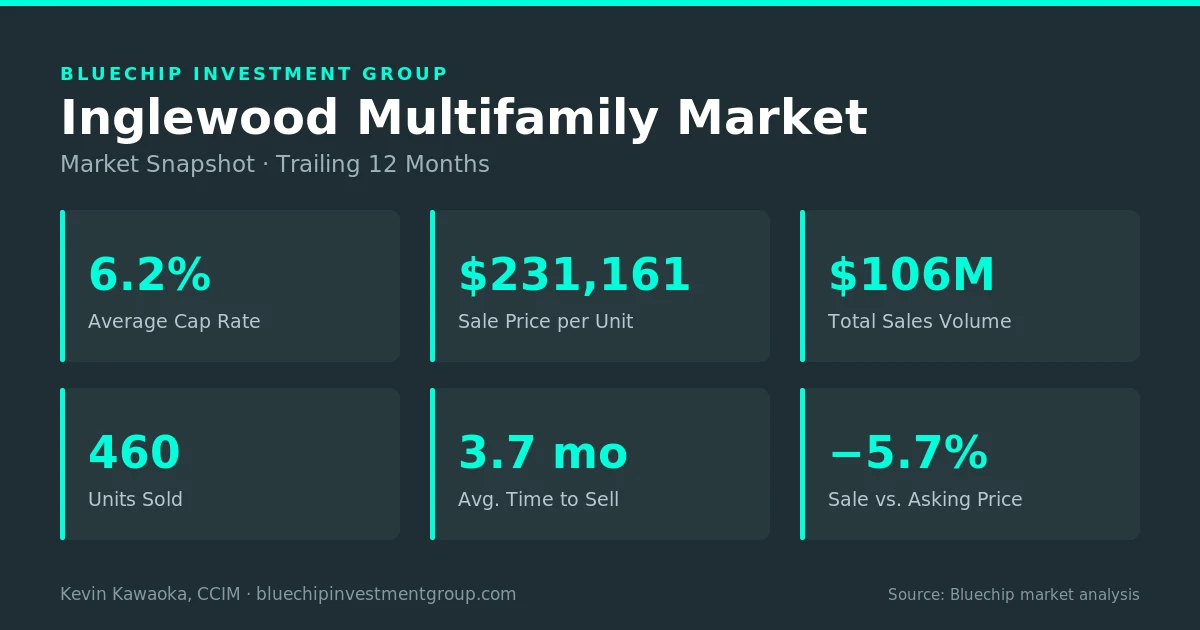
Inglewood is one of LA’s most active apartment markets right now — roughly $106M traded across 460 units over the past year, with buildings selling in about 3.7 months and within ~5.7% of asking. It’s also rent-controlled (buildings of five or more units are capped near 3% a year), so selling for top dollar means pricing the SoFi-driven growth story against that rent ceiling.
- Average cap rate: 6.2%
- Average price per unit: $231,161
- Average sale price: $2.0M
- Total sales volume: $106M across 460 units sold
- Average time to sell: 3.7 months
- Average sale price vs. original asking: −5.7%
(Figures reflect Bluechip’s analysis of Inglewood multifamily sales over the trailing 12 months; individual buildings vary by condition, rents, and location.)
The Inglewood market in 2026
Few markets in Southern California have transformed like Inglewood. SoFi Stadium, the Intuit Dome, the Kia Forum, and the Hollywood Park mixed-use development have done something most event venues never manage: they’ve converted event-day spikes into year-round household formation and durable rental demand. Add the transit build-out and the city’s role in the 2028 Olympics, and you have one of the strongest demand stories in the region.
For sellers, that translates into real, active buyer interest. Institutional capital has moved into the stadium corridor, new Class A product is fetching premium rents, and Inglewood is increasingly viewed as a value-oriented alternative to the Westside. Over the trailing 12 months, Inglewood apartment buildings traded at about a 6.2% average cap rate — notably higher (more income-friendly to buyers) than the tighter beach-city South Bay markets, a reflection of Inglewood’s largely older, value-add apartment stock and the upside investors are underwriting. Newer, stabilized product trades tighter; older value-add buildings around or above that average. And buildings here sold within about 5.7% of their original asking price — a tighter discount than many LA submarkets, and a direct measure of how much demand there is.
That demand is real and durable. But underwriting it correctly requires accounting for the one thing that makes Inglewood different from Torrance or Gardena: the city’s own rent regulations.
The critical factor: Inglewood’s rent-control ordinance
This is where Inglewood separates itself from the independent South Bay cities, and it’s the first thing a sophisticated buyer will model — so you need to understand it before you list.
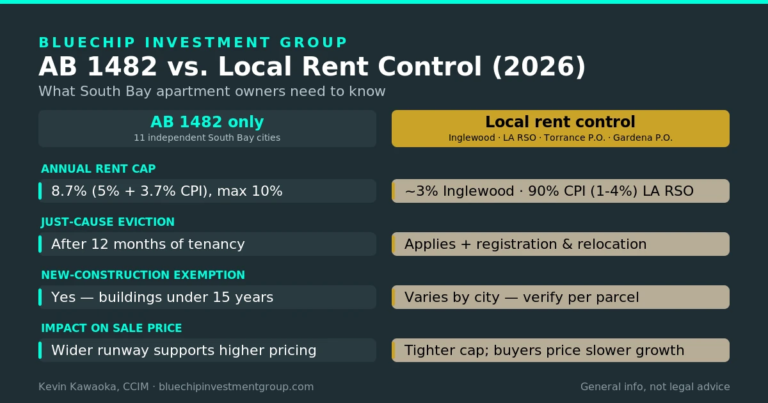
Unlike Torrance, Gardena, or Carson (which follow only statewide AB 1482), Inglewood enacted its own local Housing Protection / rent-control ordinance. The key points:
- Buildings with five or more units: annual rent increases are capped at roughly 3% (or the local cost-of-living change, whichever is greater) — about 3% for the 2025–26 period.
- Smaller buildings of four units or fewer: a higher cap applies (up to roughly 8%).
- Just-cause eviction protections apply, layered on top of statewide AB 1482.
Why this matters to your sale: a buyer isn’t only paying for today’s income — they’re underwriting how quickly they can move rents toward market. In a non-controlled city like Torrance, that path is wide open. In Inglewood, that path is capped, which directly affects the price a buyer will pay for the same in-place income. It doesn’t make Inglewood a worse market — the demand story more than compensates — but it does mean the building has to be priced and positioned with the ordinance built into the math. Get that wrong and you either scare off buyers with an unrealistic number or leave money on the table. (Caps and applicability change by period and property type; we confirm the current rules for your specific building at listing.)
How buyers value an Inglewood building
Buyers price Inglewood multifamily on income — net operating income divided by a cap rate — and cross-check against price per unit and gross rent multiplier, the same as anywhere. What’s different here is the interplay of two opposing forces:
- The growth premium — Inglewood’s trajectory (stadiums, jobs, Olympics, new development) pushes buyers to pay up and accept lower cap rates than the raw numbers might suggest.
- The regulatory ceiling — the rent ordinance limits how fast a buyer can grow that income, which pulls the other way.
The art of pricing an Inglewood building is balancing those two. The buildings that sell well — and for top dollar — are the ones where the seller documents the realistic, ordinance-aware upside (not a fantasy mark-to-market) and lets the growth story carry the rest. That’s exactly the analysis we run. If you’d like a current read on where your building would price, you can request a free, no-obligation valuation.
Who’s buying in Inglewood
The buyer pool here is deep and, increasingly, sophisticated:
- Value-add investors chasing the Inglewood growth story, looking for older buildings with reachable upside under the ordinance.
- Institutional and larger private capital that has moved into the stadium corridor and wants a foothold in the city’s long-term trajectory.
- 1031-exchange buyers with deadlines and capital to place — often the most motivated, because they must close.
- Long-term holders betting on continued appreciation through the Olympics and beyond.
Because the demand is broad and the story is compelling, a well-prepared, correctly priced Inglewood building draws strong, competitive interest. The job is to expose it to all of those pools and let them compete.
The selling process, step by step
- Define your objective. Maximize price, complete a 1031 exchange, or resolve an estate or partnership — each changes positioning and timing.
- Assemble clean financials. A current rent roll, a trailing-12-month (T12) operating statement, and copies of leases. In a rent-controlled city this is doubly important, because buyers will scrutinize where in-place rents sit relative to the cap.
- Get an ordinance-aware valuation (BOV). A broker’s opinion of value built on recent Inglewood comps, your real numbers, and realistic upside given the rent caps — not a generic estimate.
- Position and market the property. Package the growth story plus the documented, reachable upside, and expose the building to the value-add and institutional pools competing for Inglewood.
- Review offers and buyer underwriting. Price is only part of it — qualification, financing, deposit, and certainty of close matter, especially with 1031 buyers on a clock.
- Escrow, due diligence, and close. Inspections, lease and estoppel review (with rent-control compliance front and center), financing, and the details that get a complex deal closed.
Common mistakes when selling in Inglewood
- Pricing as if there’s no rent cap. Underwriting a full, fast mark-to-market that the ordinance doesn’t allow leads to an unrealistic ask and a stale listing.
- Failing to document the reachable upside. Show, unit by unit, the upside that’s actually achievable under the rules — that’s what earns competitive offers.
- Underestimating demand. Inglewood is sought-after; an under-marketed building leaves money on the table.
- Not knowing the ordinance details. Caps, exemptions, and just-cause rules all affect value; vagueness invites buyers to retrade.
- Using a residential agent. Inglewood multifamily — growth story plus rent control — is specialized; the analysis, buyer pool, and negotiation are not like selling a house.
Frequently Asked Questions
Does Inglewood have rent control?
Yes. Inglewood has its own Housing Protection / rent-control ordinance — separate from, and on top of, statewide AB 1482. For buildings of five or more units, annual increases are capped at about 3% (or the cost-of-living change, whichever is greater); smaller buildings have a higher cap. Just-cause eviction protections also apply.
How much can I raise rent on an Inglewood apartment?
For 2025–26, roughly 3% on buildings with five or more units (smaller buildings, up to about 8%). Caps change by period and property type, so confirm the current figure for your building before relying on it.
Is now a good time to sell in Inglewood?
Demand is strong. Over the last 12 months about $106M traded across 460 units, with buildings selling in roughly 3.7 months and within about 5.7% of asking — a very active market driven by SoFi, the Intuit Dome, Hollywood Park, and Olympic-related investment. The key is pricing it correctly given the rent ordinance.
How is my Inglewood building valued?
On income (cap rate), cross-checked against comparable sales, price per unit, and GRM — and adjusted for the realistic rent upside allowed under the ordinance. Get a free valuation here.
Thinking about selling your Inglewood apartment building?
Bluechip Investment Group, led by Kevin Kawaoka, CCIM, knows how to navigate both sides of Inglewood — the development-driven demand and the rent-control ceiling — to position your building for top dollar. For a clear, honest, ordinance-aware read on your building’s value, request a free, confidential valuation, see our Inglewood apartment broker page, or get in touch. No pressure, no obligation.
Related: Inglewood Apartment Broker · South Bay Apartment Broker · How Much Is My Apartment Building Worth? · Free Apartment Valuation