Selling an apartment building in Lawndale is a cash-flow story — and a quietly competitive one. Tucked in the center of the South Bay between Hawthorne, Redondo Beach, Gardena, and Torrance, Lawndale offers what value-add buyers want most: dense, older apartment stock with below-market rents, a steady working-tenant base, and no local rent control to limit upside. It’s also one of the more affordable ways into the South Bay, which keeps the buyer pool deep. Understanding how buyers price Lawndale is the difference between a quick, strong sale and a stale listing.
This guide covers how Lawndale is pricing apartment buildings in 2026, why its regulatory profile is an advantage, who’s buying, and what the process looks like from the decision to sell through close.
Lawndale apartment market at a glance (last 12 months)
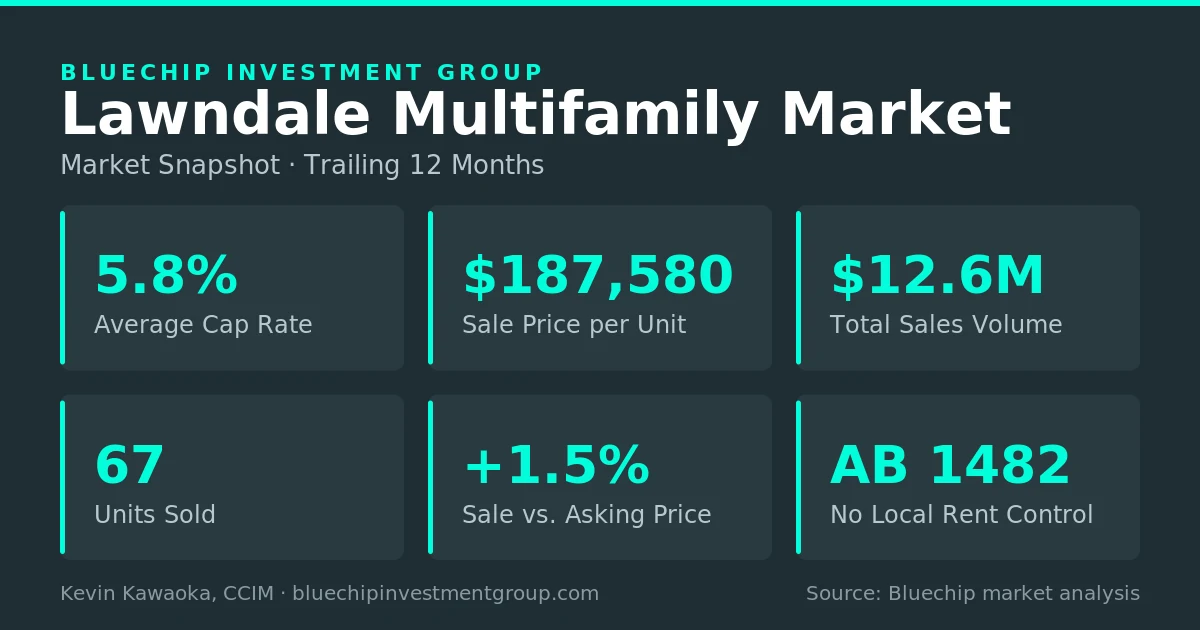
Lawndale is a value/cash-flow apartment market in the heart of the South Bay — one of the most affordable per-unit prices in the South Bay (about $187,580/unit), with older value-add stock and no local rent control (only statewide AB 1482). And it’s competitive: over the past year, Lawndale buildings sold for roughly 1.5% above their original asking price — the only South Bay submarket we track where sellers, on average, beat their ask — at a 5.8% cap rate, with about $12.6M trading across 67 units in about 4.9 months.
- Average cap rate: 5.8%
- Average price per unit: $187,580
- Average sale price: $2.5M
- Total sales volume: $12.6M across 67 units sold
- Average time to sell: 4.9 months
- Average sale price vs. original asking: +1.5% (sold above asking)
(Figures reflect Bluechip’s analysis of Lawndale multifamily sales over the trailing 12 months; individual buildings vary by condition, rents, and location.)
The Lawndale market in 2026
Lawndale’s appeal is location plus value. It sits in the geographic center of the South Bay — minutes from Hawthorne’s aerospace corridor (anchored by SpaceX), the beach cities, and the 405/105 — with a dense base of mid-century and older apartment buildings. That older stock typically carries below-market rents and room to improve, which is exactly the value-add profile drawing the most active buyers in the region right now.
Because the income is the main draw, Lawndale trades like a value/cash-flow market — averaging about a 5.8% cap rate over the trailing 12 months, higher (more income-friendly) than the beach cities — and it appeals to investors who want yield and a clear path to upside rather than paying a premium for location alone. At roughly $187,580 per unit, it’s one of the most affordable per-door entries in the South Bay, which keeps the buyer pool deep. The clearest signal of that demand: over the past year Lawndale buildings sold at about 1.5% above original asking and in roughly 4.9 months — the only South Bay submarket we track where sellers, on average, closed above their ask. For a seller, that’s an unusually strong backdrop; the key is still pricing on income and documenting the upside so the building competes for every one of those buyers.
Lawndale’s rent-regulation advantage
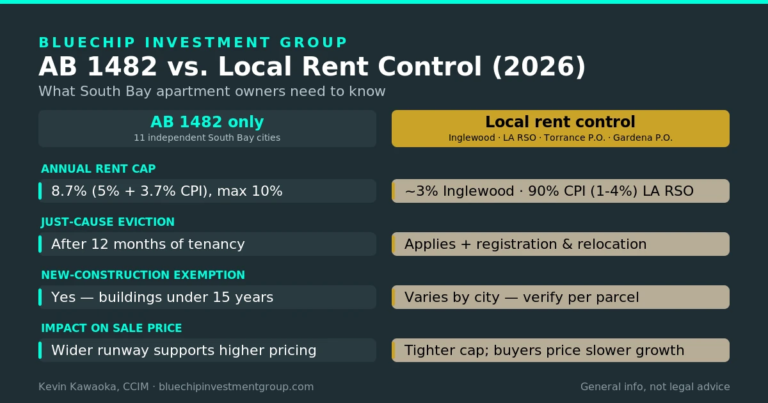
Lawndale has no local rent-control ordinance. Apartment buildings here follow only California’s statewide AB 1482 (the Tenant Protection Act) — a 5% + regional CPI cap (roughly 8.7% for the 2026–27 LA-area period), with just-cause protections after 12 months, applying to buildings 15 years and older.
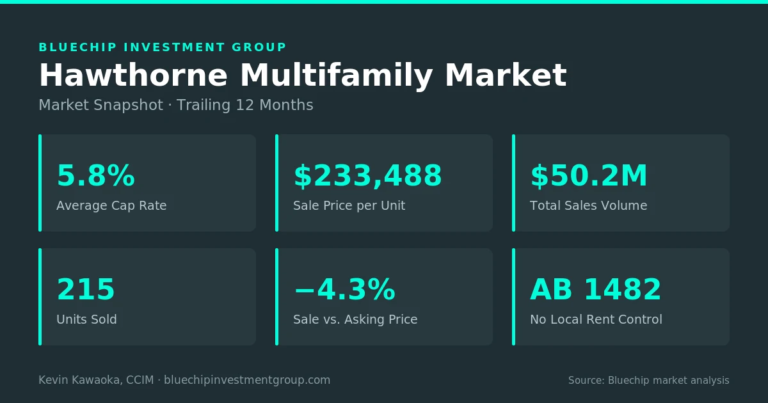
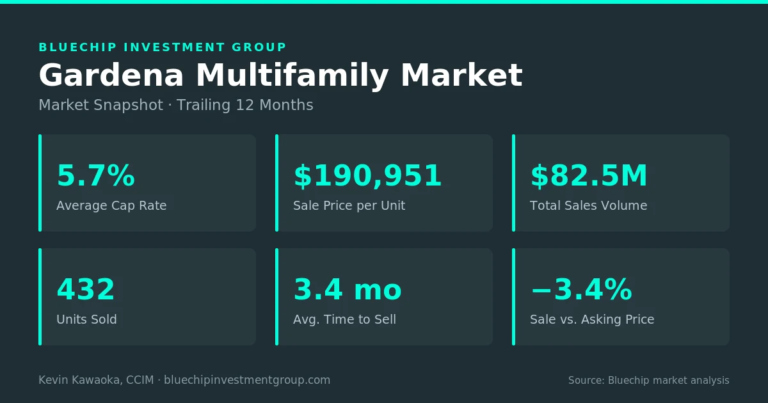
Why that matters at sale time: a buyer can underwrite moving rents toward market far more realistically than in a rent-controlled city. Compare Lawndale to Inglewood (local cap near 3% on 5+ unit buildings) or the City of Los Angeles (RSO) — under AB 1482 only, Lawndale’s reachable upside is wider, and that supports a higher price. It’s the same structural advantage Hawthorne, Gardena, and Torrance enjoy, and it’s worth making explicit to buyers. (We confirm the applicable framework for your specific building at listing.)
How buyers value a Lawndale building
Buyers price Lawndale multifamily on income — net operating income divided by a cap rate — then cross-check against:
- Gross rent multiplier (GRM) — a quick screen of price to gross rent.
- Price per unit — versus recent comparable sales nearby.
- Price per square foot — useful across different unit mixes.
- Rent upside — the gap between in-place and market rents, often the single biggest driver of a competitive offer in a value market like Lawndale.
The buildings that sell best are the ones where the seller documents that upside clearly — unit by unit — and lets the income story carry the deal. If you want a current read on where your building would price, you can request a free, no-obligation valuation.
Who’s buying in Lawndale
- Cash-flow-focused private investors who want yield and Lawndale’s higher cap rates.
- Value-add operators targeting older buildings with below-market rents and renovation upside.
- First-time and step-up South Bay buyers drawn to Lawndale’s relative affordability.
- 1031-exchange buyers with deadlines and capital to place — often the most motivated.
Because Lawndale offers income, upside, and an affordable entry point, a well-prepared, correctly priced building draws competitive interest.
The selling process, step by step
- Define your objective. A straight sale, a 1031 exchange, or an estate/partnership resolution each shapes positioning and timing.
- Assemble clean financials. A current rent roll, a trailing-12-month (T12) operating statement, and copies of leases — the single biggest factor in how quickly buyers can move.
- Get an accurate valuation (BOV). Built on recent Lawndale comps, your real numbers, and a realistic read on upside.
- Position and market the property. Lead with income and documented upside, and expose the building to the value-add and 1031 buyer pools.
- Review offers and buyer underwriting. Price, qualification, financing, deposit, and certainty of close — especially with 1031 buyers on a clock.
- Escrow, due diligence, and close. Inspections, lease and estoppel review, financing, and the details that get a deal closed cleanly.
Common mistakes when selling in Lawndale
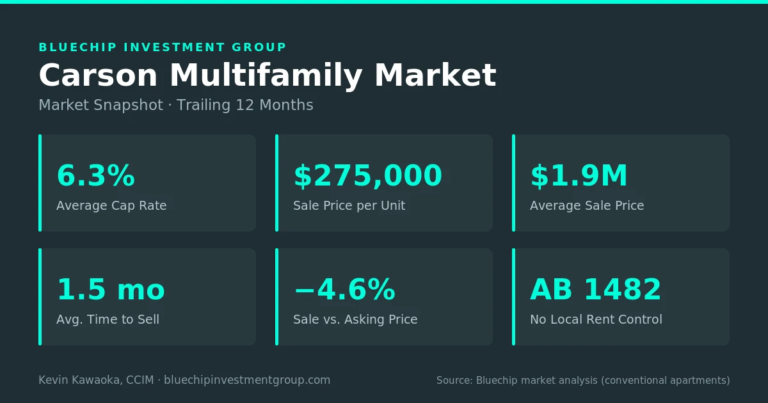
- Pricing on location instead of income. Lawndale is a value/cash-flow market; price it on the numbers, not beach-city comps.
- Not documenting the upside. Below-market rents are worth far more shown unit by unit than asserted.
- Going to market without a clean rent roll and T12. It invites buyers to retrade.
- Underplaying the no-rent-control advantage. It’s a real selling point versus Inglewood and the City of LA — use it.
- Using a residential agent. Multifamily is underwritten, marketed, and negotiated completely differently than a house.
Frequently Asked Questions
Does Lawndale have rent control?
No. Lawndale has no local rent-control ordinance. Apartments here follow only California’s statewide AB 1482 (5% + CPI cap, ~8.7% for the 2026–27 period; just-cause after 12 months) — a meaningful advantage over rent-controlled cities like Inglewood or the City of Los Angeles.
What’s a good cap rate in Lawndale right now?
Lawndale buildings traded at about a 5.8% average cap rate over the trailing 12 months — a value/cash-flow level, higher (more income-friendly) than the tighter beach-city South Bay markets. Get a current valuation for your specific building.
How is my Lawndale apartment building valued?
On income (net operating income divided by a cap rate), cross-checked against comparable sales, price per unit, and GRM, then adjusted for rent upside. Get a free valuation here.
Is now a good time to sell in Lawndale?
The data says yes. Over the last 12 months, Lawndale buildings sold at about 1.5% above original asking and in roughly 4.9 months — the only South Bay submarket we track where sellers, on average, beat their ask. Demand for affordable value-add South Bay product is strong; the key is still pricing on income and documenting the upside.
Thinking about selling your Lawndale apartment building?
Bluechip Investment Group, led by Kevin Kawaoka, CCIM, specializes in South Bay multifamily — Lawndale included — and knows how to price and position a value-add building for top dollar. For a clear, honest read on your building’s value, request a free, confidential valuation, see our Lawndale apartment broker page, or get in touch. No pressure, no obligation.
Related: Lawndale Apartment Broker · South Bay Apartment Broker · How to Sell an Apartment Building in Hawthorne · How Much Is My Apartment Building Worth?
Market figures reflect Bluechip’s analysis of recent Lawndale/South Bay multifamily activity and are for illustration only; cap rates and values vary by building, location, and condition. The AB 1482 cap reflects the current LA-area period — confirm current rules for your specific building before relying on them.