Selling an apartment building in Torrance is a different transaction than selling one almost anywhere else in Los Angeles County — and the differences work in your favor. Torrance sits inside one of the most supply-constrained, fundamentally sound multifamily markets in Southern California, and unlike the City of Los Angeles, it carries no local rent-control ordinance. For an owner deciding whether to sell, those two facts shape everything: how buyers underwrite your building, how aggressively they’ll price it, and how clean the path to closing is.
This guide walks through what a Torrance apartment owner needs to understand before listing — how the market is pricing buildings in 2026, why Torrance’s regulatory profile is an advantage, who’s actually in the buyer pool, and what the process looks like from the decision to sell through close. It’s written from the perspective of a broker who works this submarket specifically, not as a general overview.
Torrance apartment market at a glance
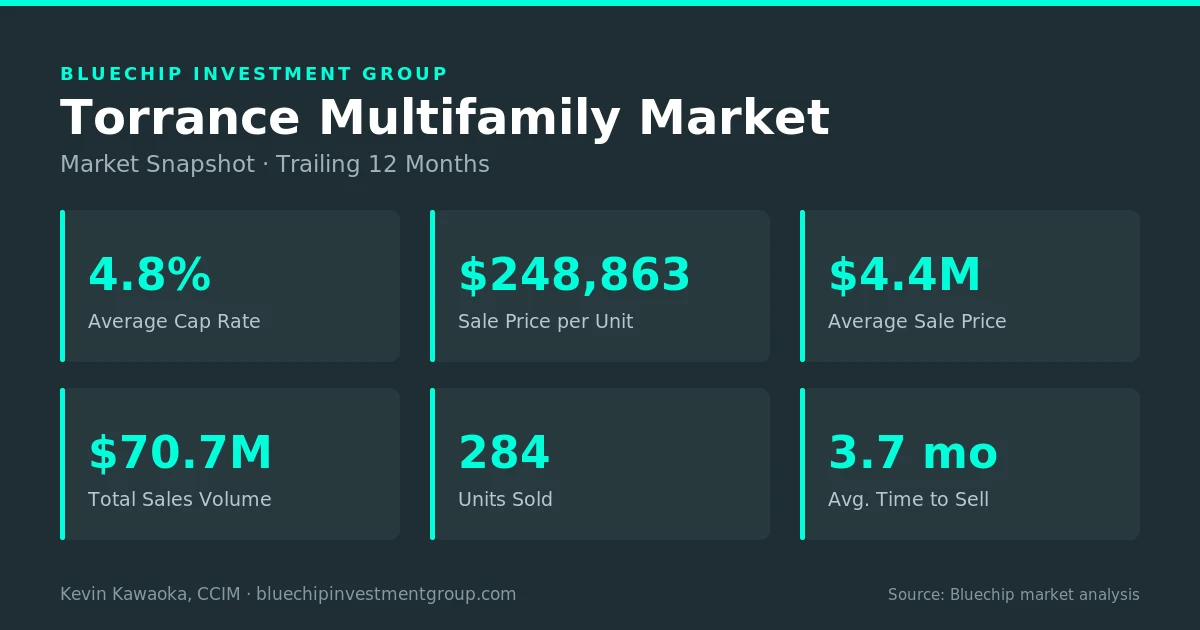
Torrance is one of the South Bay’s most supply-constrained, fundamentally sound apartment markets — about $70.7M traded across 284 units over the last 12 months, selling in roughly 3.7 months, at an average 4.8% cap rate and $248,863 per unit. And unlike the City of LA, Torrance has no local rent control (it follows statewide AB 1482 only), giving buyers a cleaner path to market rents — a real advantage at sale time.
The Torrance multifamily market in 2026
Torrance is anchored by one of the deepest, most diversified employment bases in the South Bay — American Honda’s North American headquarters, Robinson Helicopter, a large medical and aerospace sector, and the retail gravity of the Del Amo area. That economic base produces steady, white-collar and skilled rental demand, and it doesn’t swing the way single-industry towns do.
On the supply side, almost nothing new is being built. The South Bay is one of the most supply-constrained apartment submarkets in the region, and Torrance in particular is largely built out. When there’s durable demand and effectively no new competition, existing buildings hold value and trade actively — which is exactly the dynamic in front of sellers today.
That shows up in the numbers. Here’s what the Torrance apartment market actually did over the trailing 12 months:
- Average cap rate: 4.8%
- Average price per unit: $248,863
- Average sale price: $4.4M
- Total sales volume: $70.7M across 284 units sold
- Average time to sell: 3.7 months
- Average sale price vs. original asking: −9.2%
A few things stand out for an owner thinking about selling. First, a 4.8% average cap rate is tight — among the lower, more seller-favorable rates in Los Angeles County — which means buyers are paying a premium for every dollar of income a Torrance building produces. That’s a direct reflection of how supply-constrained and sought-after this market is. Second, $70.7M of volume across 284 units is a genuinely active, liquid market: there are real, qualified buyers transacting right now, not a frozen one. And the most active among them are still chasing mid-tier, value-add buildings with below-market rents — exactly the Torrance profile.
Third — and this is the stat most owners overlook — buildings sold about 9% below their original asking price on average. That gap is the cost of overpricing. List too high and you either sit on the market or negotiate down anyway, usually after burning the early weeks of momentum that produce the strongest offers. Pricing it right from day one is what protects both your number and your timeline. (Figures reflect Torrance multifamily sales over the trailing 12 months plus Bluechip’s analysis; individual buildings vary by location, condition, and in-place rents.)
How Torrance apartment buildings are valued
Buyers price multifamily on income, but they look at several lenses at once, and understanding them is the difference between leaving money on the table and getting full value:
- Capitalization (cap) rate — net operating income divided by price. The primary lens for stabilized buildings. In a low-cap-rate market like Torrance, small improvements to NOI translate into outsized value.
- Gross rent multiplier (GRM) — price relative to gross annual rent, a quick screen buyers use to compare deals.
- Price per unit and price per square foot — how your building stacks up against recent comparable sales nearby.
- Rent upside — the gap between in-place rents and current market rents. In a value-add-hungry market, documented upside is often what drives competitive offers.
The single most valuable thing you can do before listing is have these run correctly and honestly, ideally against recent Torrance comparables rather than a generic estimate. If you want a current read on where your building would price, you can request a free, no-obligation valuation and we’ll build it from real comps and your rent roll.
Torrance’s rent-regulation advantage
This is where Torrance separates itself from most of the county, and it’s worth understanding because sophisticated buyers price it in.
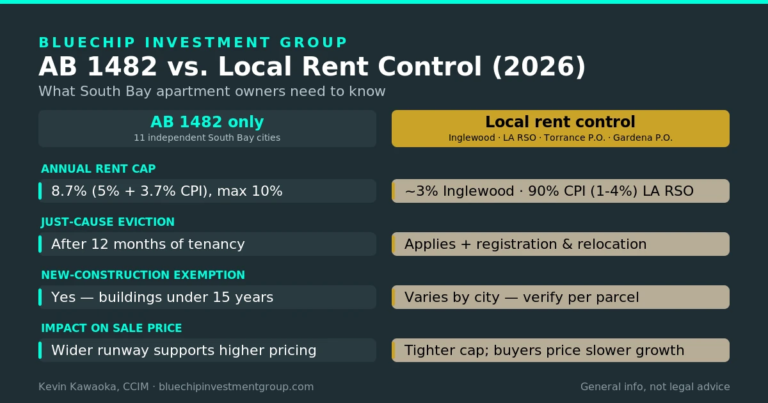
Torrance has no local rent-control ordinance. Apartment buildings here fall under California’s statewide law, AB 1482 (the Tenant Protection Act), and nothing stricter. AB 1482 caps annual rent increases at 5% plus regional CPI — roughly 8.7% for the 2026–27 LA-area period — and requires just-cause for eviction after a tenant has been in place 12 months. It generally applies to buildings 15 years and older.
Contrast that with the City of Los Angeles, where most older buildings fall under the LA Rent Stabilization Ordinance (RSO) — far tighter annual caps, plus relocation and just-cause rules that materially constrain income. A buyer comparing a Torrance building to an RSO building in the City of LA is comparing two very different income trajectories. Under AB 1482, a buyer can model bringing rents toward market more realistically, which supports a higher price and a cleaner underwrite. It’s a genuine, structural advantage of owning in Torrance — and presenting it correctly is part of maximizing your sale. (Regulations change and applicability depends on the property; we confirm the current framework for your specific building at listing.)
One important local nuance — mailing address vs. jurisdiction: not every property with a Torrance mailing address is actually inside the City of Torrance. Some addresses in the “Torrance” postal area (often called Torrance P.O.) are legally within the City of Los Angeles — governed by City of LA zoning and real-estate laws, including the LA City Rent Stabilization Ordinance (RSO) — despite using that mailing address. The city on the envelope doesn’t decide the rules — the property’s actual jurisdiction does — so we verify it for every building before pricing, since getting it wrong can materially mis-state a building’s reachable upside and value.
Who’s buying in Torrance
The Torrance buyer pool is deep and active, and it isn’t one type of buyer:
- Private and family investors seeking stable, supply-constrained South Bay cash flow.
- 1031-exchange buyers with hard deadlines and real money to place — often the most motivated, because they must close.
- Value-add operators hunting buildings with below-market rents they can reposition under AB 1482’s more workable framework.
- Local owners expanding their footprint in a market they already know and trust.
Because demand is broad and supply is thin, a well-prepared, correctly priced Torrance building frequently draws multiple offers. The listing broker’s job is to expose it to all of those pools at once and create competition — not to find a single buyer.
The selling process, step by step
- Decide your objective. A straight sale to maximize price, a 1031 exchange to defer taxes, or an estate or partnership resolution each change how a building should be positioned and timed.
- Assemble your financials. A clean current rent roll, a trailing-12-month (T12) operating statement, and copies of current leases. This is the single biggest factor in how quickly and credibly buyers can move.
- Get an accurate valuation (BOV). A broker’s opinion of value built on recent Torrance comps, your in-place numbers, and a realistic read on upside — not a generic algorithm.
- Position and market the property. Package it to the right buyer pools, lead with documented upside and the AB 1482 advantage, and expose it broadly to create competition.
- Review offers and buyer underwriting. Price is only part of an offer — buyer qualification, financing, deposit, and ability to close matter just as much.
- Escrow, due diligence, and close. Inspections, lease and estoppel review, loan processing, and the dozens of details that decide whether a deal closes smoothly. This is where experience earns its keep.
Common mistakes Torrance owners make when selling
- Pricing off an outdated cap rate or an old appraisal. This market moves; an old number can misprice a building badly.
- Not documenting the upside. “Rents are under market” is worth far more shown with a unit-by-unit comparison than asserted.
- Going to market without a clean rent roll and T12. It signals disorganization and invites retrading.
- Underestimating the tax hit — or the 1031 option. Planning the exchange before listing protects your proceeds.
- Using a residential agent for a commercial asset. Multifamily is underwritten, marketed, and negotiated completely differently than a house.
Frequently Asked Questions
Does Torrance have rent control?
No. Torrance has no local rent-control ordinance. Apartments here follow California’s statewide AB 1482 only — a meaningful advantage over the City of LA’s stricter RSO.
How is my Torrance apartment building valued?
Primarily on income, through cap rate and GRM, benchmarked against recent comparable sales and adjusted for rent upside. You can get a free valuation here.
Do I have to sell to get a valuation?
No. Many owners request one simply to understand their equity, plan a refinance, or evaluate a future 1031 exchange. It’s free and there’s no obligation.
How long does it take to sell?
Over the last 12 months, Torrance apartment buildings sold in about 3.7 months on average. Pricing and preparation drive that timeline; coming to market organized is the biggest accelerator.
Thinking about selling your Torrance apartment building?
Bluechip Investment Group, led by Kevin Kawaoka, CCIM, specializes in South Bay multifamily — Torrance included — with a focus on buildings from 5 to 100+ units. If you want a clear, honest read on what your building would sell for today, request a free, confidential valuation, see our Torrance apartment broker page for local detail, or get in touch. No pressure, no obligation — just a straight answer.
Related: Torrance Apartment Broker · South Bay Apartment Broker · Free Apartment Valuation