If you own an apartment building in the City of Los Angeles, how Los Angeles rent control applies depends mostly on when your building was built.
Older buildings fall under the City’s Rent Stabilization Ordinance (RSO). Newer buildings fall under California’s AB 1482 cap and the City’s Just Cause Ordinance.
Many buildings with a Los Angeles mailing address sit in a separate city, like Santa Monica, Beverly Hills or Culver City, with its own rules.
This guide covers the 2026 numbers for Los Angeles rent control, which buildings are covered, what owners must register and pay, and how the rules differ across the Westside. Every rule here comes from the City of Los Angeles Housing Department (LAHD) or the city or county agency that sets it. This is general information, not legal advice.
The short answer (2026)
- RSO buildings: most units built on or before October 1, 1978 can go up 3% for July 1, 2026 through June 30, 2027, once every 12 months.
- No add-ons: for notices served on or after February 2, 2026, the City no longer allows the extra utility percentage or the 10% increase for an added dependent.
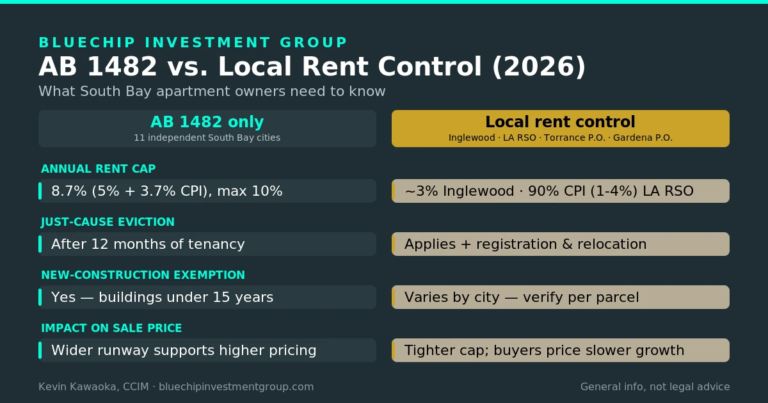
- Newer buildings: units outside the RSO fall under the City’s Just Cause Ordinance, and buildings at least 15 years old are capped by AB 1482 at 8.7% for August 1, 2026 through July 31, 2027.
- Check your building: look up the address on ZIMAS and open the Housing tab to see its RSO status.
What is Los Angeles rent control (the RSO)?
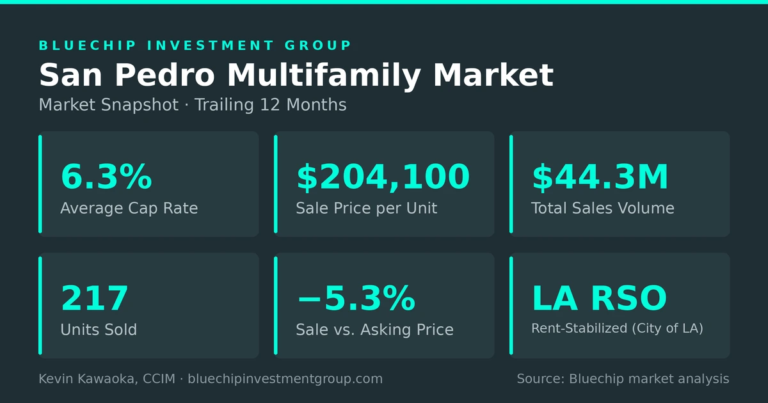
The Rent Stabilization Ordinance is the City of Los Angeles rent control law. It limits how much and how often you can raise rent on a covered unit, sets the legal reasons for an eviction, and requires owners to register their units with LAHD every year. It applies only inside the City of Los Angeles, which includes neighborhoods like West LA, Palms, Mar Vista, Venice, Westwood, Brentwood, Century City, Beverlywood, Koreatown, San Pedro and Wilmington.
Which buildings are covered by Los Angeles rent control?
LAHD says the RSO covers rental units on a property built on or before October 1, 1978. Covered units include:
- Apartments, condominiums, townhomes and duplexes
- Accessory dwelling units (ADUs and JADUs) on a covered property
- Two or more single-family houses on one parcel
- Units built after July 15, 2007 that replace demolished RSO units
LAHD lists these as exempt:
- A single-family house that is the only residential structure on the parcel
- Units built after October 1, 1978, in most cases
- Affordable or luxury units that LAHD has exempted
- Units in a commercial building converted to rental use after October 1, 1978
The surest check is ZIMAS, the City’s parcel lookup. Enter the address, open the Housing tab, and the RSO status is shown for the property. Read more on LAHD’s page, What is Covered under the RSO.
How much can I raise rent under Los Angeles rent control in 2026?
The allowable increase is 3% for July 1, 2026 through June 30, 2027. Under a formula the City adopted effective February 2, 2026, the yearly rate is 90% of the average change in the Consumer Price Index, with a floor of 1% and a cap of 4%. The old formula had a 3% floor and an 8% cap.
- Once a year: you can raise rent on a covered unit once every 12 months.
- No utility surcharge: owners who provided gas or electricity used to add 1% for each. For notices served on or after February 2, 2026, the increase cannot include any utility percentage.
- No dependent increase: the extra 10% for an added dependent is no longer allowed as of February 2, 2026.
- Notice: state law requires 30 days’ written notice for an increase of less than 10%.
- When a unit turns over: LAHD says new rent levels are established after a tenant moves out voluntarily or is evicted for nonpayment or a lease violation.
The City posts the current rate on LAHD’s Renter Protections page.
Newer buildings: AB 1482 and the Los Angeles Just Cause Ordinance
A building outside the RSO is not free of rules. Inside the City of Los Angeles, two other layers usually apply.
| Rule | Which units | What it does |
|---|---|---|
| LA Just Cause Ordinance | Most units not under the RSO, including houses and condos | Requires a legal reason to evict once a tenant’s first lease ends or 6 months pass, whichever comes first; does not cap rent |
| California AB 1482 | Buildings at least 15 years old, unless exempt | Caps yearly increases at 5% plus regional CPI, never more than 10%; 8.7% in the LA area for August 1, 2026 to July 31, 2027 |
Just Cause properties also get a yearly LAHD registration bill of $31.05 per rental unit. For how AB 1482 works and its exemptions, see our AB 1482 and South Bay rent control guide.
What RSO owners have to register and pay
Annual registration. Every RSO unit that is rented or offered for rent must be registered with LAHD each year. The fee is $38.75 per unit.
You may pass half of it to the tenant as a $1.61 monthly surcharge with 30 days’ written notice. LAHD says owners cannot legally collect rent unless the registration fees are paid.
You must also give each tenant a copy of the registration certificate and post the RSO notice at the property.
Relocation assistance. No-fault evictions, such as owner or family move-in, an Ellis Act withdrawal, demolition or a government order to vacate, require relocation assistance, a filing with LAHD and fees. For RSO units, from July 1, 2026 through June 30, 2027, LAHD’s Relocation Assistance Bulletin lists:
| Tenant | Under 3 years | 3 years or more, or low income |
|---|---|---|
| Eligible | $11,000 | $14,400 |
| Qualified (62+, disabled, or with minor children) | $23,150 | $27,400 |
Owners who hold no more than four residential units and a single-family house may pay a reduced amount for an owner or family move-in: $10,550 for an eligible household and $21,250 for a qualified household. Payment is due within 15 days of serving the notice.
Large increases. Under the City’s economic displacement rule, a tenant who gets an increase of more than 8% within 12 months (for August 1, 2025 to July 31, 2026) may choose relocation assistance instead. This matters most for newer buildings under AB 1482, where the cap is higher.
Los Angeles address, different rules
A Los Angeles mailing address does not mean your building is in the City of Los Angeles. Several Westside cities, and the County’s unincorporated areas, have their own rent control laws:
- Santa Monica: a 2.6% general adjustment from September 1, 2026, capped at $70 for units with a maximum allowable rent of $2,674 or more, and a $240 yearly registration fee per unit. See Santa Monica Maximum Lawful Rent.
- Beverly Hills: 3.6% for most units (Chapter 6), set each June; buildings with a certificate of occupancy after February 1, 1995 are exempt. See the Beverly Hills Rent Stabilization Ordinance.
- Culver City: 3.25% for June 1, 2026 through June 30, 2027 on parcels with two or more units built on or before February 1, 1995, with a $177 per unit registration fee due by July 31. See Culver City rent control.
- Unincorporated LA County: 1.919% for most covered units through June 30, 2027, according to the County’s Department of Consumer and Business Affairs.
When in doubt, check the parcel on ZIMAS. If it isn’t in the City of Los Angeles, ZIMAS won’t show it, and the city it is in sets the rules.
Why rent control affects what your building is worth
Buyers price the rent increases they can actually reach. Under Los Angeles rent control, rents on long-term tenancies move about 3% a year, so a building with below-market rents is priced on the income it has today and on how often units turn over. A Palms RSO building is priced off Palms sales of similar RSO buildings, and a newer Mar Vista building under AB 1482 is priced off Mar Vista sales of newer buildings. If you’re weighing a sale, our guide to selling a rent-controlled apartment building covers how buyers underwrite RSO rent rolls and how to prepare.
For sales above $5.4 million, see our Measure ULA guide for apartment sellers.
Los Angeles rent control, area by area
City of Los Angeles (RSO): West LA, Palms, Mar Vista, Venice, Westwood, Brentwood, Century City, Beverlywood
Own rent control laws: Santa Monica, Beverly Hills, Culver City
For the full list of areas we cover, see our Los Angeles apartment broker page.
Frequently Asked Questions
How much can I raise rent in Los Angeles in 2026?
For a unit under the City of Los Angeles RSO, the allowable increase is 3% for July 1, 2026 through June 30, 2027, once every 12 months. For a newer building in the City that is at least 15 years old, the AB 1482 cap is 8.7% for August 1, 2026 through July 31, 2027. Santa Monica, Beverly Hills and Culver City set their own caps.
Is my building under Los Angeles rent control?
If it is in the City of Los Angeles and was built on or before October 1, 1978, it is most likely covered by the RSO. A single-family house that is the only home on its parcel is exempt. Enter the address on ZIMAS and open the Housing tab to see the RSO status.
Can I add a utility surcharge or raise rent for an added occupant?
No, not for notices served on or after February 2, 2026. The City removed the extra 1% for gas and 1% for electricity and the 10% increase for an added dependent.
What rent can I charge when an RSO unit becomes vacant?
LAHD says new rent levels are established after a tenant moves out voluntarily or is evicted for nonpayment or a lease violation. Check LAHD’s rules for your situation before setting a new rent.
Do I have to register my RSO units?
Yes. Every rented RSO unit must be registered with LAHD each year, at $38.75 per unit. You may pass half to the tenant as a $1.61 monthly surcharge with 30 days’ notice, and you cannot legally collect rent until the fees are paid.
How much relocation do I owe for a no-fault eviction?
For RSO units from July 1, 2026 through June 30, 2027, LAHD lists $11,000 to $14,400 for an eligible household and $23,150 to $27,400 for a qualified household, depending on tenancy length and income. Smaller owners may pay less for an owner or family move-in.
Does Los Angeles rent control affect my building’s value?
Yes. Buyers price the rent increases they can reach, so an RSO building with long-term tenants is valued on today’s income and how often units turn over. A free, no-obligation valuation shows what the rules mean for your building.
Thinking about selling, and want to know how the rules affect your price?
Bluechip Investment Group, led by Kevin Kawaoka, CCIM, sells apartment buildings across Los Angeles and the South Bay, including RSO buildings and buildings under the Westside cities’ own rent control laws. We price each building for the market it actually trades in. Request a free, confidential valuation, see our Los Angeles apartment broker page, or get in touch.