Selling an apartment building in San Pedro is a different transaction than selling one in the independent South Bay cities — and getting it right means understanding the one factor that drives value here: this is the City of Los Angeles, so most buildings fall under the LA Rent Stabilization Ordinance (RSO). A sophisticated buyer will model the RSO before anything else, because it caps how fast they can move rents toward market — which directly shapes the price they’ll pay. Pair that with San Pedro’s distinct waterfront, port-town character and an active sales market, and you have a submarket that rewards a broker who underwrites the ordinance correctly.
This guide covers how San Pedro is pricing apartment buildings in 2026, exactly how the City of LA’s rent rules work and why buyers price them in, who’s buying, and what the process looks like from the decision to sell through close.
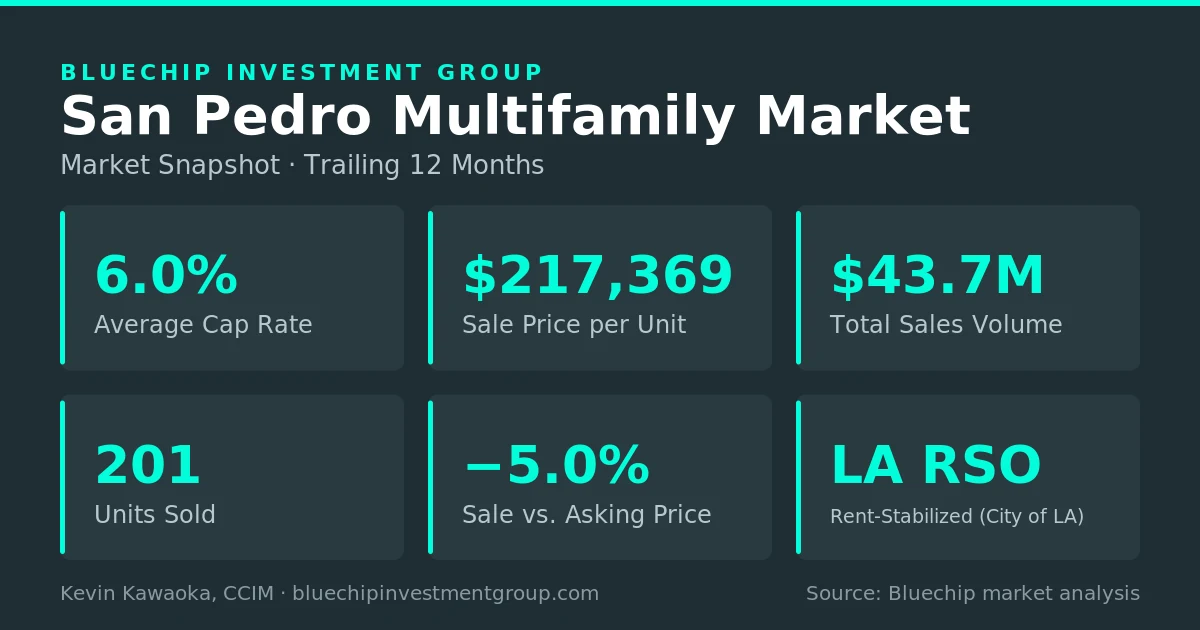
San Pedro apartment market at a glance (last 12 months)
San Pedro is an active, value-oriented Harbor submarket of the City of Los Angeles, so most older buildings are rent-stabilized under the LA RSO (plus AB 1482 for newer units). Over the past year about $43.7M traded across 201 units at a 6.0% average cap rate and roughly $217,369 per unit, with buildings selling within about 5% of asking in 5.2 months. Pricing for top dollar means weighing San Pedro’s waterfront-driven demand against the RSO rent ceiling.
- Average cap rate: 6.0%
- Average price per unit: $217,369
- Average sale price: $2.1M
- Total sales volume: $43.7M across 201 units sold
- Average time to sell: 5.2 months
- Average sale price vs. original asking: −5.0%
(Figures reflect Bluechip’s analysis of San Pedro multifamily sales over the trailing 12 months; individual buildings vary by condition, rents, RSO status, and location.)
The San Pedro market in 2026
San Pedro is unlike anywhere else in the Harbor area. It’s a waterfront, port-anchored community with hillside and ocean-view stock, a walkable historic downtown, and a major redevelopment story in West Harbor (the waterfront project on the old Ports O’ Call site) that’s reshaping the area’s long-term appeal. That mix of coastal character, relative affordability versus the beach cities, and a long-term growth narrative keeps demand steady.
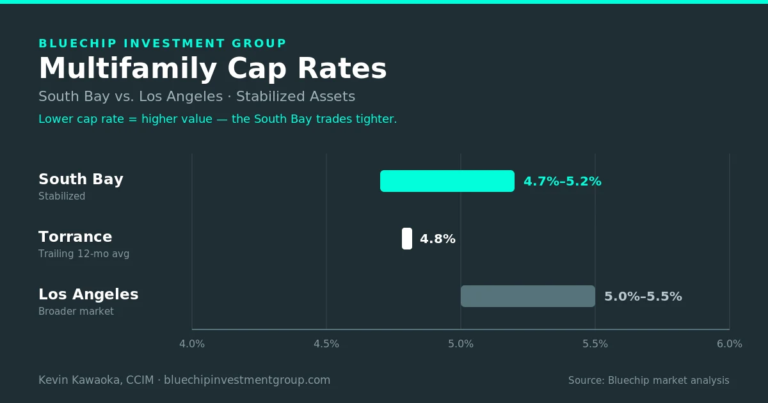
The numbers reflect a real, active market: over the trailing 12 months roughly $43.7M traded across 201 units at about a 6.0% average cap rate and $217,369 per unit, with buildings closing within about 5% of asking in 5.2 months. That 6.0% cap is a value/income level — higher (more income-friendly to buyers) than the tight beach cities — reflecting San Pedro’s largely older, rent-stabilized stock and the upside investors underwrite. But that upside is capped by the City of LA’s rent rules, which is the one thing every seller here needs to understand before listing.
The critical factor: San Pedro is under the LA RSO
This is where San Pedro separates itself from the independent South Bay cities, and it’s the first thing a serious buyer models — so you need to understand it before you list.
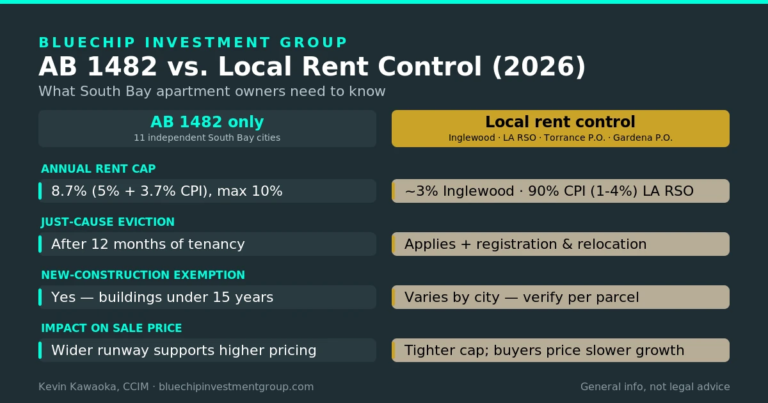
San Pedro is part of the City of Los Angeles, so rental units with a certificate of occupancy on or before October 1, 1978 are covered by the Rent Stabilization Ordinance (RSO). The key points for 2026:
- Allowable annual increase: 3% for the current period (through June 30, 2026).
- From July 1, 2026, a new formula applies: 90% of CPI, capped between 1% and 4% a year (and the old utility/additional-occupant add-ons are gone).
- Just-cause eviction, annual RSO registration, and relocation-assistance requirements all apply.
- Newer units (after October 1978) generally fall under statewide AB 1482 instead (5% + CPI, ~8.7% for 2026).
Why this matters to your sale: a buyer isn’t only paying for today’s income — they’re underwriting how quickly they can move rents toward market, and the RSO caps that path tightly (around 3% a year). That directly affects the price a buyer will pay for the same in-place income. It doesn’t make San Pedro a weak market — the waterfront demand story more than holds it up — but it does mean the building has to be priced and positioned with the RSO built into the math. Get that wrong and you either scare off buyers with an unrealistic number or leave money on the table. (RSO status turns on your building’s certificate-of-occupancy date and unit specifics; we confirm exactly what applies to your property at listing.)
How buyers value a San Pedro building
Buyers price San Pedro multifamily on income — net operating income divided by a cap rate — and cross-check against price per unit and gross rent multiplier, the same as anywhere. What’s specific to San Pedro is the interplay of two forces:
- The demand story — the waterfront, West Harbor redevelopment, and relative affordability push buyers to compete.
- The RSO ceiling — the rent ordinance limits how fast a buyer can grow income, which pulls the other way.
The art of pricing a San Pedro building is balancing those two. The buildings that sell well — and for top dollar — are the ones where the seller documents the realistic, RSO-aware upside (not a fantasy mark-to-market) and lets the location story carry the rest. That’s exactly the analysis we run. You can request a free, no-obligation valuation for a current read.
Who’s buying in San Pedro
- RSO-savvy value-add investors who know how to underwrite reachable upside under the ordinance.
- Cash-flow buyers drawn to San Pedro’s 6%-area cap rates and Harbor-area demand.
- 1031-exchange buyers with deadlines and capital to place — often the most motivated.
- Long-term holders betting on the waterfront and West Harbor redevelopment.
Because demand is steady and the location story is compelling, a well-prepared, correctly priced San Pedro building draws competitive interest — provided it’s priced with the RSO in mind.
The selling process, step by step
- Define your objective. A straight sale, a 1031 exchange, or an estate/partnership resolution each shapes positioning and timing.
- Assemble clean financials. A current rent roll, a trailing-12-month (T12) operating statement, leases, and your RSO registration records — buyers will scrutinize where in-place rents sit relative to the cap.
- Get an RSO-aware valuation (BOV). Built on recent San Pedro comps, your real numbers, and realistic upside given the rent caps — not a generic estimate.
- Position and market the property. Package the waterfront/location story plus the documented, reachable upside, and expose it to the value-add and 1031 pools.
- Review offers and buyer underwriting. Price, qualification, financing, deposit, and certainty of close.
- Escrow, due diligence, and close. Inspections, lease and estoppel review (with RSO compliance front and center), financing, and the details that get the deal done.
Common mistakes when selling in San Pedro
- Pricing as if there’s no rent cap. Underwriting a fast, full mark-to-market the RSO doesn’t allow leads to an unrealistic ask and a stale listing.
- Not documenting the reachable upside. Show, unit by unit, the upside actually achievable under the RSO — that’s what earns competitive offers.
- Ignoring RSO compliance. Registration, allowable-increase history, and relocation rules all affect value; gaps invite buyers to retrade.
- Confusing San Pedro with the independent South Bay cities. It’s the City of LA — the rules are stricter than Torrance or Gardena, and pretending otherwise costs you credibility with buyers.
- Using a residential agent. RSO multifamily is underwritten, marketed, and negotiated completely differently than a house.
Frequently Asked Questions
Does San Pedro have rent control?
Yes. San Pedro is part of the City of Los Angeles, so rental units with a certificate of occupancy on or before October 1, 1978 are covered by the LA Rent Stabilization Ordinance (RSO). The allowable annual increase is 3% through June 30, 2026; from July 1, 2026 a new formula (90% of CPI, capped 1%–4%) applies. Newer units generally follow statewide AB 1482.
How much can I raise rent on a San Pedro RSO unit?
For the current period (through June 30, 2026), 3%. Starting July 1, 2026, the cap is based on 90% of CPI within a 1%–4% range. Confirm your building’s RSO status and the current figure before relying on it.
What’s a good cap rate in San Pedro right now?
San Pedro buildings traded at about a 6.0% average cap rate over the trailing 12 months — a value/income level, higher (more buyer-friendly) than the tighter beach-city markets. Get a current valuation for your specific building.
Is now a good time to sell in San Pedro?
Demand is steady — about $43.7M traded across 201 units over the last year, with buildings selling within roughly 5% of asking in about 5.2 months, supported by the waterfront and West Harbor redevelopment story. The key is pricing it correctly given the RSO.
Thinking about selling your San Pedro apartment building?
Bluechip Investment Group, led by Kevin Kawaoka, CCIM, knows how to navigate both sides of San Pedro — the waterfront-driven demand and the LA RSO ceiling — to position your building for top dollar. For a clear, honest, ordinance-aware read on your building’s value, request a free, confidential valuation, see our San Pedro & Wilmington apartment broker page, or get in touch. No pressure, no obligation.
Related: San Pedro & Wilmington Apartment Broker · South Bay Apartment Broker · How to Sell an Apartment Building in Inglewood · How Much Is My Apartment Building Worth?
Market figures reflect Bluechip’s analysis of recent San Pedro multifamily sales and are for illustration only; cap rates and values vary by building, condition, RSO status, and location. RSO rules, caps, and the post–July 2026 formula are summarized here and change by period — confirm current rules for your specific building before relying on them.